Qingxin Yichuang Launches Dino OS for Intelligent Robots, Featuring Amoo Humanoid
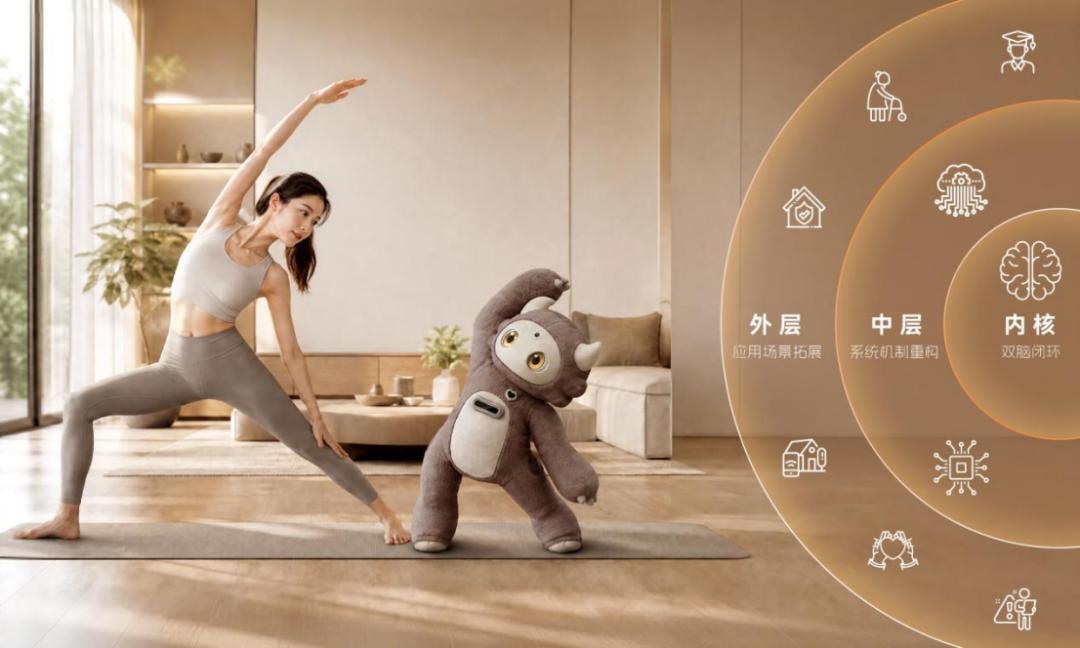
Qingxin Yichuang has officially launched Dino OS, a proprietary operating system designed to address the challenges of developing intelligent robots, particularly for the consumer market. The company also unveiled its first smart robot product, Amoo, an 80cm tall, plush-covered humanoid robot. Amoo is equipped with a full suite of sensors for interaction and emotional analysis, aiming to provide a dynamic and engaging user experience. CTO Zeng Jun, formerly a core model scientist at autonomous driving giant Cruise, highlighted the complexities of robot development compared to self-driving cars, emphasizing the need for efficient output management with limited power and computational resources. He stated that a unified underlying system is crucial for the continuous iteration and long-term appeal of consumer-grade robots. Dino OS features a three-layer architecture: Infra, Brain, and Module. The Infra layer ensures consistent data sharing and communication between different robot functions, preventing errors and ensuring stable operation. The Brain layer employs a unique "dual-brain closed-loop" design, combining a "slow brain" for complex task understanding and a "fast brain" for immediate social responses, with a cerebellum for real-time physical execution and safety. This allows for more natural and fluid interactions, where actions and cognitive processes occur simultaneously. The Module layer simplifies scenario expansion by providing reusable behavior units and unified interfaces, allowing developers to build new functionalities without extensive low-level coding. This modular approach aims to reduce development cycles from years to months and foster efficient incremental development, ultimately enabling robots to evolve into truly dynamic and lifelike intelligent agents.
The introduction of Dino OS by Qingxin Yichuang signals a strategic shift towards creating a standardized software foundation for consumer robots, aiming to overcome the fragmentation and inefficiencies prevalent in current development practices. By abstracting complex hardware interactions and providing a unified platform for iterative development, the company seeks to accelerate innovation and enhance user experience. This approach addresses a critical bottleneck in the consumer robotics market, where robust human-robot interaction and continuous software updates are key differentiators. The "dual-brain" architecture, if effectively implemented, could offer a significant advantage in creating more responsive and seemingly intuitive robotic behavior, moving beyond mere task execution to more embodied intelligence. The long-term success will depend on the OS's ability to foster a vibrant developer ecosystem and maintain its performance and adaptability as hardware capabilities evolve over the next decade.
AI-generated to prompt reflection — not editorial opinion, not advice, not a statement of fact. How this works.