Radio Telescope Array Detects Polarized Light from Distant Gamma-Ray Burst
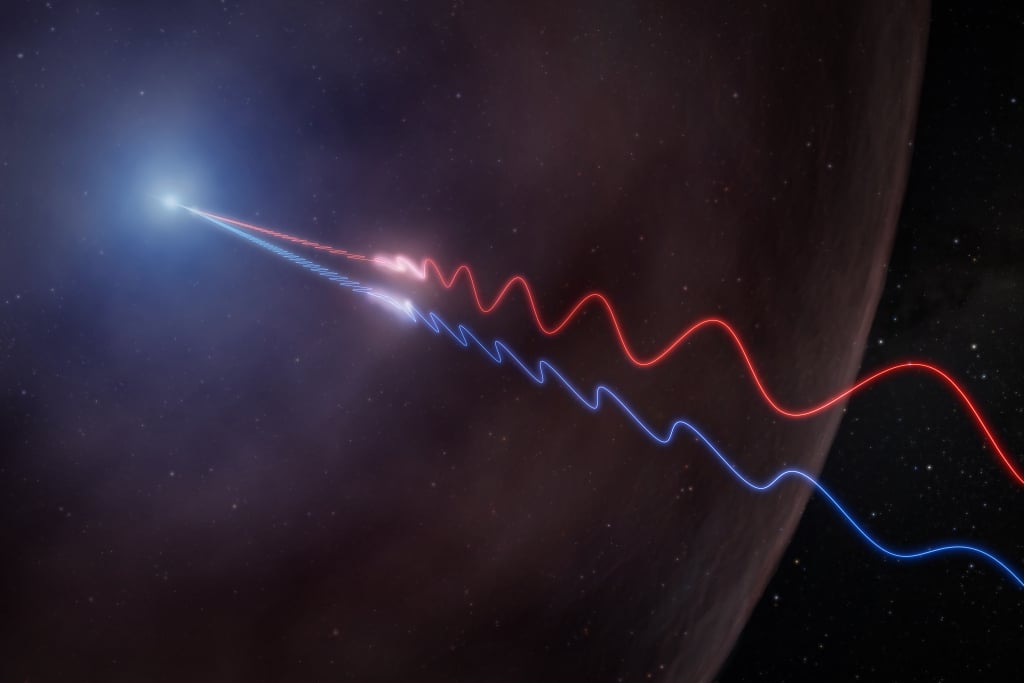
On March 10, 2026, the Fermi telescope's gamma-ray burst team announced the detection of a long-duration gamma-ray burst. This cosmic event originated from a star's explosion within a dense, highly magnetized cloud of hydrogen gas, identified as an HII region. This region, characterized by ionized hydrogen, was formed by the stellar winds of a massive young star. Following the detection, astronomers promptly directed numerous telescopes towards the burst and its subsequent afterglow. Among these instruments was the National Science Foundation's Karl Jansky Very Large Array, which played a role in observing the phenomenon.
The detection of polarized light from a gamma-ray burst within a magnetized hydrogen cloud offers crucial data for understanding the physics of extreme cosmic events. This observation allows scientists to probe the conditions of the progenitor star and its immediate environment, potentially revealing details about magnetic field strengths and their influence on stellar explosions. Future analysis could refine models of gamma-ray burst emission mechanisms and the evolution of massive stars in dense interstellar media. Understanding these processes is vital for comprehending the broader cosmic landscape and the distribution of heavy elements throughout the universe.
AI-generated to prompt reflection — not editorial opinion, not advice, not a statement of fact. How this works.