Rare 'Blue Eye Pulsar' Emits Radio Signals After Decades of Silence
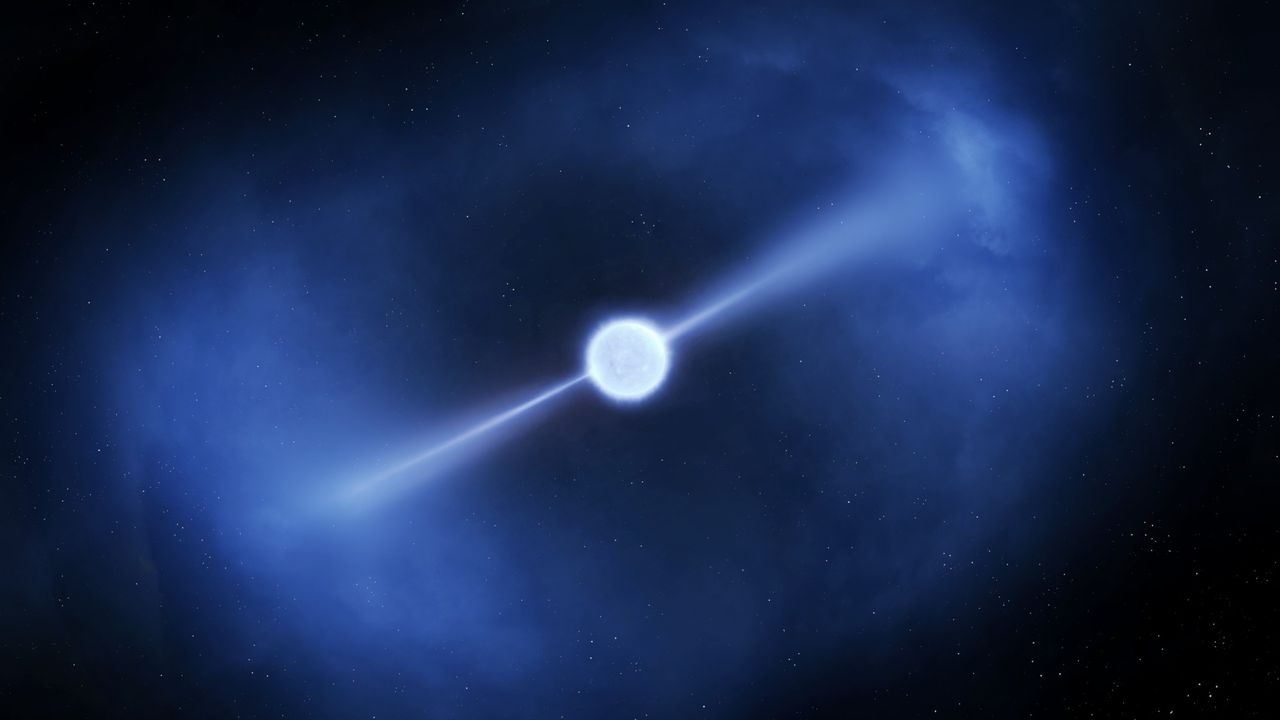
Astronomers have successfully detected radio signals emanating from a neutron star identified as the 'Blue Eye Pulsar.' This celestial object, previously believed to be dormant, has been the subject of a search for decades. The detection marks a significant event, as the pulsar had been silent for a considerable period. Neutron stars are the incredibly dense remnants of massive stars that have undergone supernova explosions. The 'Blue Eye Pulsar' is a rare type of neutron star, and its renewed activity has captured the attention of the scientific community. Researchers will now analyze these newly received signals to gain further insights into the physics of pulsars and the evolution of these extreme cosmic objects. This discovery opens up new avenues for studying phenomena that were previously inaccessible due to the pulsar's silence.
The renewed emission from the 'Blue Eye Pulsar' after a prolonged period of silence presents an opportunity to study the dynamic processes within neutron stars. Understanding the mechanisms that trigger such intermittent activity could refine models of stellar evolution and compact object physics. This event highlights the ongoing challenges and rewards of deep-space observation, where long-term monitoring can yield unexpected scientific breakthroughs. Future research may focus on identifying potential precursors or environmental factors that influence pulsar behavior, potentially leading to more accurate predictions of such cosmic events.
AI-generated to prompt reflection — not editorial opinion, not advice, not a statement of fact. How this works.