Rare Encounter: Black Hole Shreds Star in Galactic 'Nowhere'
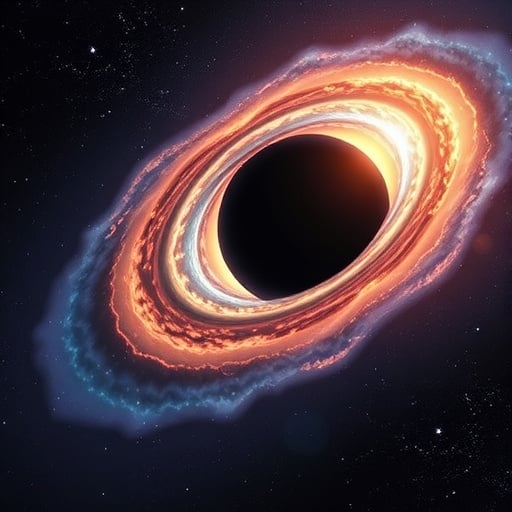
Astronomers have described the rare phenomenon of a black hole encountering and destroying a star. Such events are estimated to occur only once every 100,000 years within a galaxy. When a supermassive black hole meets a star, its immense gravitational pull tears the star apart. This process, known as "spaghettification," involves the black hole stretching the star along one axis. The intense tidal forces rip a stream of gas from the star, which then coalesces into a disk surrounding the black hole. While the scenario sounds like science fiction, it represents a real, albeit infrequent, cosmic event with observable astrophysical consequences.
This celestial event, while rare, highlights the fundamental physics governing gravitational interactions in the cosmos. The immense gravitational forces at play demonstrate the power of black holes, which can dramatically alter stellar matter. Understanding these interactions is crucial for refining astrophysical models and comprehending galactic evolution. The "spaghettification" process, though visually striking, is a direct consequence of differential gravity, where the pull on the near side of the star is significantly stronger than on the far side. Future observations of such events could provide valuable data for testing theories of gravity and the behavior of matter under extreme conditions, offering insights into the dynamics of accretion disks and the processes that fuel active galactic nuclei.
AI-generated to prompt reflection — not editorial opinion, not advice, not a statement of fact. How this works.