Rare Semi-Albino Southern Right Whale Calf Spotted with Mother in Santa Catarina
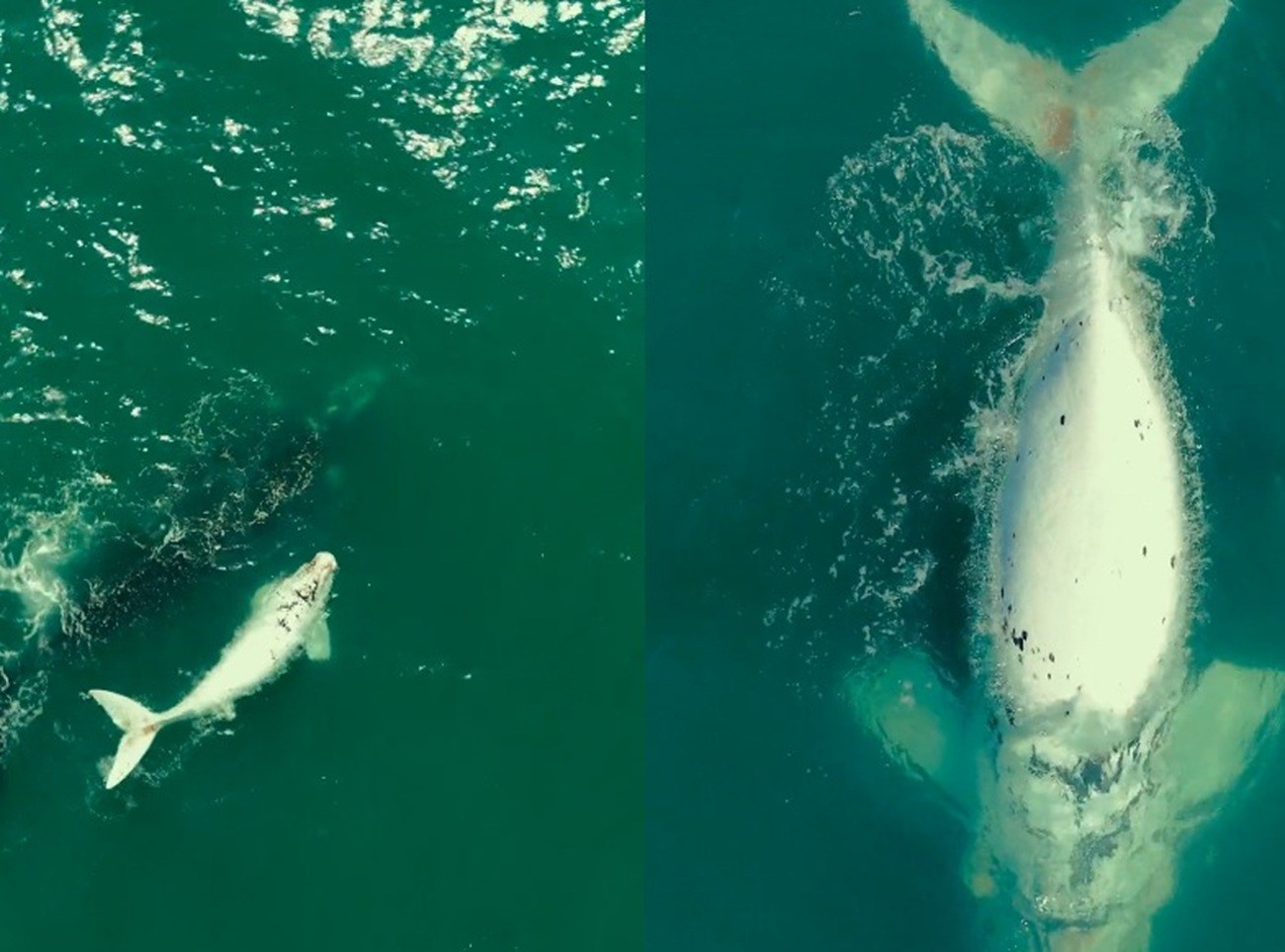
A rare semi-albino Southern Right Whale calf was observed alongside its mother on Monday, August 27th, at Praia da Ribanceira in Imbituba, located on the southern coast of Santa Catarina, Brazil. Photographer José Gil Alves de Medeiros captured the sighting, which is considered exceptional. According to the Southern Right Whale Research and Conservation Program (ProFranca), such animals are sighted only once every two seasons on the Brazilian coast, with this genetic characteristic appearing in approximately 3% of the species. Medeiros first noticed the calf on Saturday, August 25th, using a drone, and observed it again on Monday between Praia da Ribanceira and Barra de Ibiraquera. Karina Groch, who leads the Southern Right Whale Project, explained that semi-albino whales are born white with black spots, but their skin later turns gray as they mature, though the spots remain distinguishable. This genetic trait, which typically results in male calves, occurs in about 3% of Southern Right Whale births. While most calves with this condition are male, Groch noted that females with semi-albino characteristics have been recorded in Santa Catarina and globally. Southern Right Whales are commonly seen along the Santa Catarina coast between July and September, migrating to warmer tropical waters for mating and calving.
The sighting of a rare semi-albino Southern Right Whale calf highlights the genetic diversity within the species and the importance of dedicated conservation programs. While the rarity of the calf is a compelling natural phenomenon, it also underscores the vulnerability of such unique individuals to environmental pressures and potential threats in their habitat. Continued monitoring and research, as exemplified by ProFranca and the Southern Right Whale Project, are crucial for understanding population dynamics and ensuring the long-term survival of Southern Right Whales. The observation serves as a reminder of the intricate biological processes at play and the need for robust conservation strategies that account for genetic variations and their implications for species resilience in the face of evolving ecological challenges.
AI-generated to prompt reflection — not editorial opinion, not advice, not a statement of fact. How this works.