Reinforcement Learning Enhances Quantum Error Correction Control
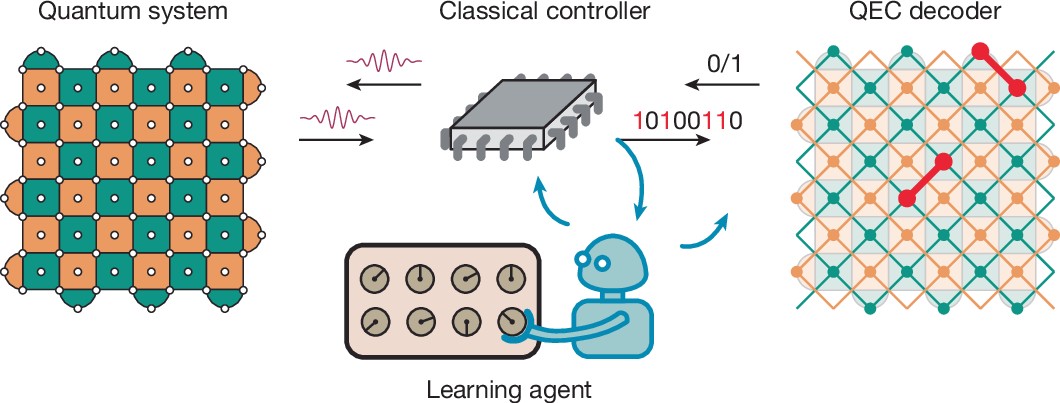
Researchers have developed a novel approach utilizing reinforcement learning (RL) to control quantum error correction (QEC). This method aims to improve the efficiency and effectiveness of protecting quantum information from errors, which is a critical challenge in building stable quantum computers. The RL agent learns optimal strategies for applying error correction codes based on the observed state of the quantum system. This dynamic adaptation allows for more precise and responsive error correction compared to traditional, pre-programmed methods. The study demonstrates that RL can significantly reduce the resources needed for QEC while maintaining high fidelity. This breakthrough has the potential to accelerate the development of fault-tolerant quantum computing. The researchers believe this RL-driven QEC could be a key component in scaling up quantum processors. By intelligently managing the complex interplay of quantum states and error syndromes, RL offers a powerful new tool for quantum technology.
The integration of reinforcement learning into quantum error correction represents a significant advancement in managing the inherent fragility of quantum information. By enabling adaptive control strategies, RL addresses the limitations of static QEC protocols, which may not optimally respond to real-time quantum state fluctuations. This approach aligns with the broader trend of leveraging AI to solve complex computational problems, particularly in nascent technological fields like quantum computing. The potential for RL to reduce resource overhead and improve fidelity could accelerate the timeline for achieving fault-tolerant quantum computation, a prerequisite for many advanced quantum applications. Future research may explore the scalability of these RL agents and their performance across diverse quantum hardware architectures, considering the trade-offs between computational complexity and error correction efficiency.
AI-generated to prompt reflection — not editorial opinion, not advice, not a statement of fact. How this works.