Researchers Develop Programmable Organic Synapses for Advanced Neuromorphic Computing
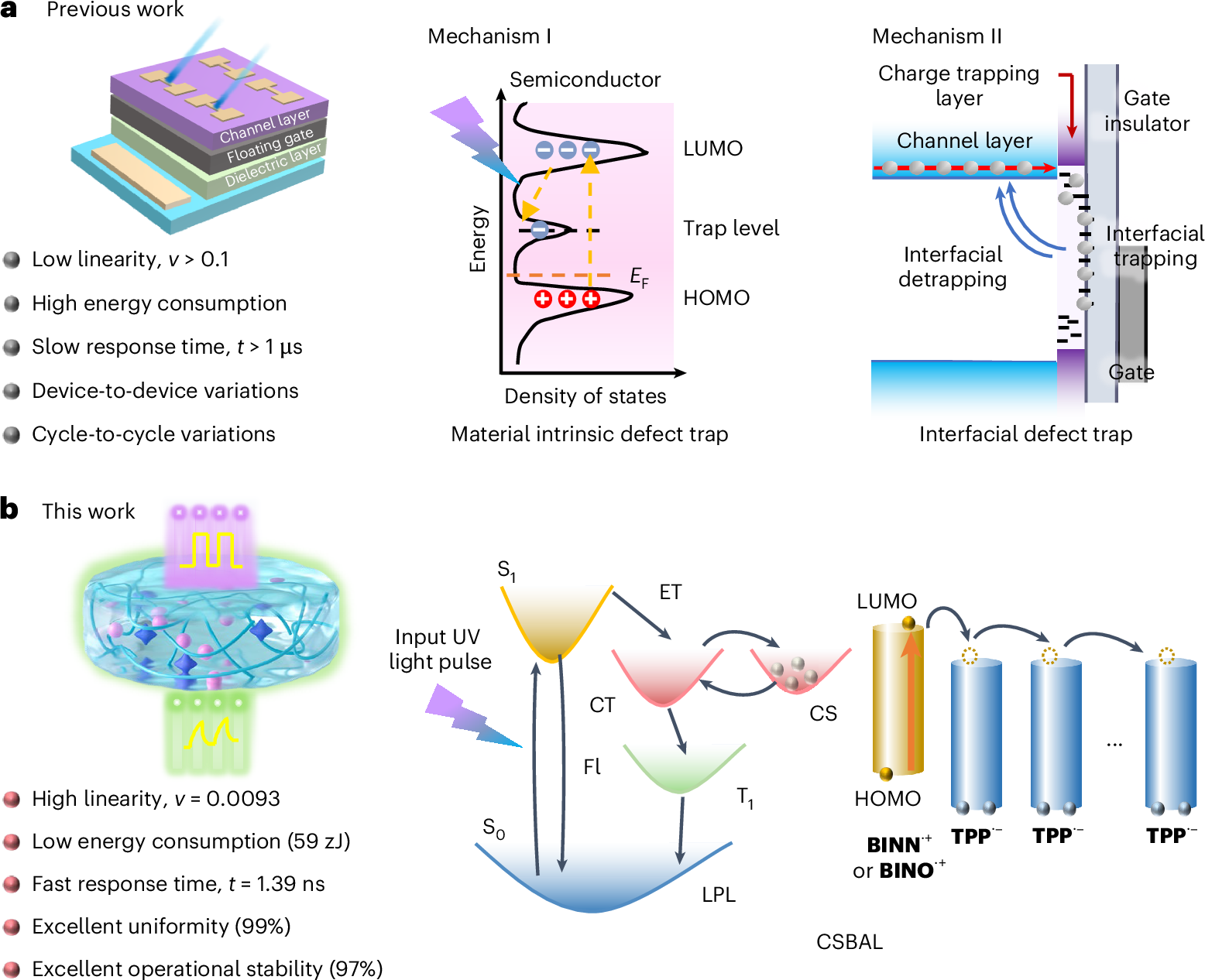
Scientists have engineered organic synapses that exhibit programmable linearity, a crucial advancement for neuromorphic computing. These novel synapses mimic the behavior of biological neurons, enabling more efficient and powerful artificial intelligence systems. The programmability allows for fine-tuning the synaptic response, which is essential for complex learning algorithms. This breakthrough could pave the way for next-generation AI hardware that is more energy-efficient and capable of handling intricate tasks. The development focuses on creating artificial neural networks that can learn and adapt in ways similar to the human brain. By controlling the linearity of the organic synapses, researchers can achieve higher precision in signal transmission and processing. This is a significant step towards realizing the full potential of neuromorphic computing architectures. The ultimate goal is to build AI systems that are not only faster but also consume considerably less power than current technologies. This research contributes to the ongoing effort to bridge the gap between biological intelligence and artificial systems.
The development of programmable organic synapses represents a significant stride in the quest for more biologically plausible and efficient neuromorphic computing architectures. By enabling tunable linearity, these components address a key challenge in replicating the nuanced signal processing of biological neural networks. This advancement could unlock new paradigms in artificial intelligence, potentially leading to systems that are more adaptable and energy-efficient, particularly as computational demands escalate with the proliferation of AI applications. The ability to program synaptic behavior offers a pathway to overcome some limitations of current digital architectures, moving closer to hardware that learns and processes information in a manner analogous to the human brain. Future research will likely focus on scalability, long-term stability, and integration into larger-scale neuromorphic systems.
AI-generated to prompt reflection — not editorial opinion, not advice, not a statement of fact. How this works.