Review of Anu Muhammad's "Capital: Circulation of Capital, Vol. 2"
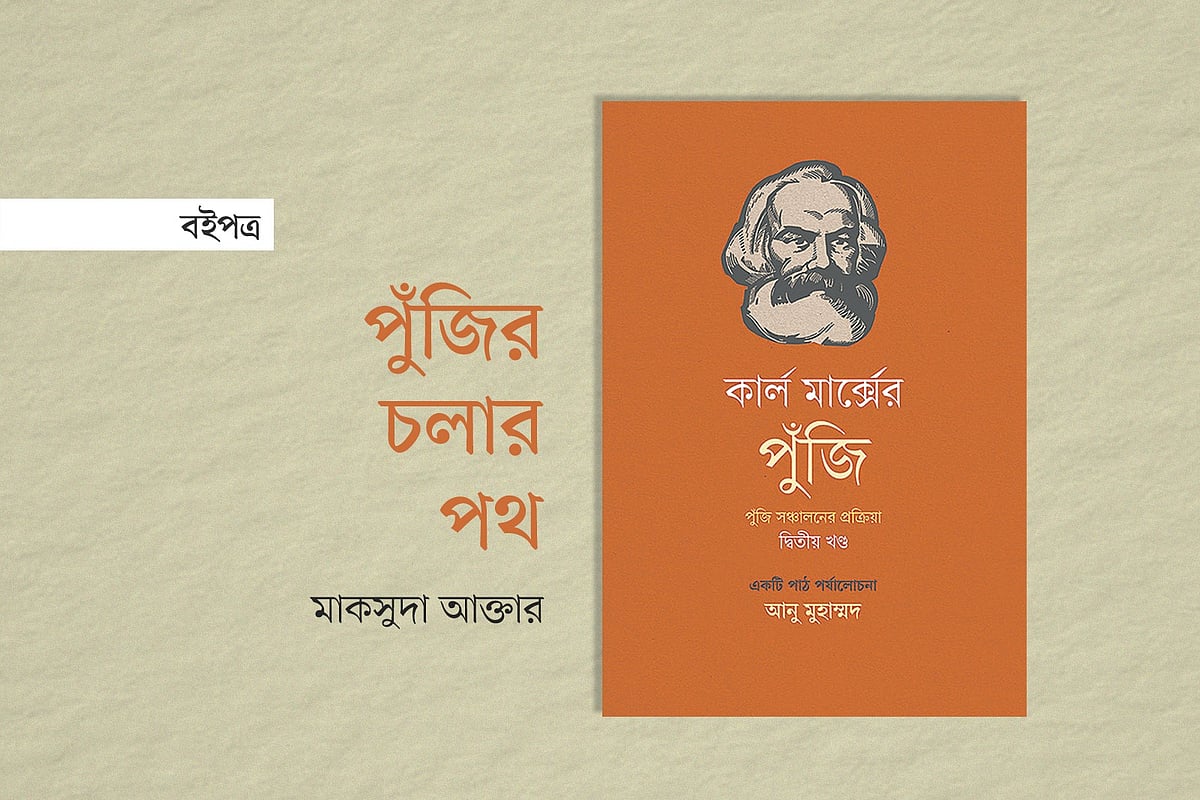
This is a review of Anu Muhammad's "Capital: Circulation of Capital, Volume 2," which analyzes Karl Marx's foundational work. The book is not a direct translation but incorporates Muhammad's own insights and omits repetitive elements from Marx's original text. The review highlights that Friedrich Engels, as the editor of Marx's "Capital," provided the introduction and addressed controversies arising from the first volume. The subtitle, "The Process of Circulation of Capital," is significant, contrasting with the first volume's subtitle, "The Process of Production of Capital." A key focus of this volume is how value and surplus value operate within market processes. The book is divided into 28 sections, each exploring distinct economic implications. It examines the causal links between capital's various paths to production and presents comparative views from Physiocrats and other economists. Marx posits that money transforms into productive capital by acquiring means of production and labor power, driving the capitalist production process. This process requires capitalists to secure production sites and machinery before hiring labor. In concentrated production, labor becomes detached. With the abolition of serfdom, former serfs became wage laborers for landowners, facilitating the creation and circulation of productive capital. Muhammad's review details how the accumulation of capital and the transformation of surplus value into productive capital, alongside expanded reproduction, also lead to the accumulation of money, some of which remains inactive. It also discusses the workings of exchange in simple reproduction. Industrial capital is presented as the sole vehicle for capital's existence, appropriating surplus value and perpetuating itself, thereby creating class conflict between capitalists and wage laborers. When monetary and commodity capital function alongside industrial capital in various businesses, their distinct existence dissolves as industrial capital subsumes them. Industrial capital develops unidirectionally due to the social division of labor. Marx argues that capital's dynamism extends beyond production into the general circulation of commodities, analyzing three laws of capital's movement, each indicating departure, transition, and return, unifying production and distribution. Productive capital is supplied in the form of means of production. The review also touches upon the differing cyclical periods of fixed and circulating components of productive capital. It contrasts François Quesnay's view of agricultural capital as the only truly productive form with Adam Smith's application of this division to all capital, defining initial advances as fixed capital and annual advances as circulating capital. Marx, however, prefers "capital of circulation" over Smith's "circulating capital" and critiques David Ricardo's theories. The book delves into the analysis of labor, production, and circulation time. It explores the principles of economic exploitation, the structural contradictions between capitalists and laborers, and the inherent instability of capitalist economic relations. The review concludes that this work is a successful addition to Marx's theoretical discourse, examining the reproduction and circulation of aggregate capital, and comparatively discussing the views of Physiocrats and Adam Smith. Smith's concept of commodity value as rent, wages, and profit is challenged by Marx's analysis, as is Ricardo's similar stance. Marx formulates the replacement of fixed capital, noting that while long-lasting assets like machinery have extended lifespans, their components may require annual replacement. The review highlights an analysis of how capitalist accumulation and reproduction influence workers' consumption and alter inventory ratios, with accumulation and reproduction categorized into two forms. The current world is described as capital-controlled, where capital, defined broadly to include money, business assets, technology, and human skills, is a source for generating more income. The book's analysis of society's economic structure, economic exploitation, and the unstable nature of capitalist relations is presented as a significant contribution to Marx's theoretical legacy. The publication details include: Publisher: Prothoma Prokashon, Release: March 2026, Cover Artist: Anisuzzaman Sohel, Pages: 248, Price: 600 Taka.
This review of Anu Muhammad's analysis of Marx's "Capital" offers a deep dive into the mechanics of capital circulation and its societal implications. By focusing on the dialectical relationship between capital accumulation and labor, the work illuminates the inherent tensions within capitalist systems. The analysis of fixed versus circulating capital, and the differing economic theories surrounding them, underscores the evolving understanding of economic drivers. Examining how capital's dynamism extends beyond production into broader circulation reveals the complex feedback loops influencing markets and labor. The review implicitly prompts consideration of how contemporary economic models, influenced by technological advancements and globalization, navigate these same fundamental principles of value creation, surplus appropriation, and systemic reproduction. Understanding these historical critiques provides a crucial lens for evaluating the sustainability and equity of current global economic structures over the next decade.
AI-generated to prompt reflection — not editorial opinion, not advice, not a statement of fact. How this works.
