Rio de Janeiro: Criminals use buses as barricades after police clash in Jacarepaguá
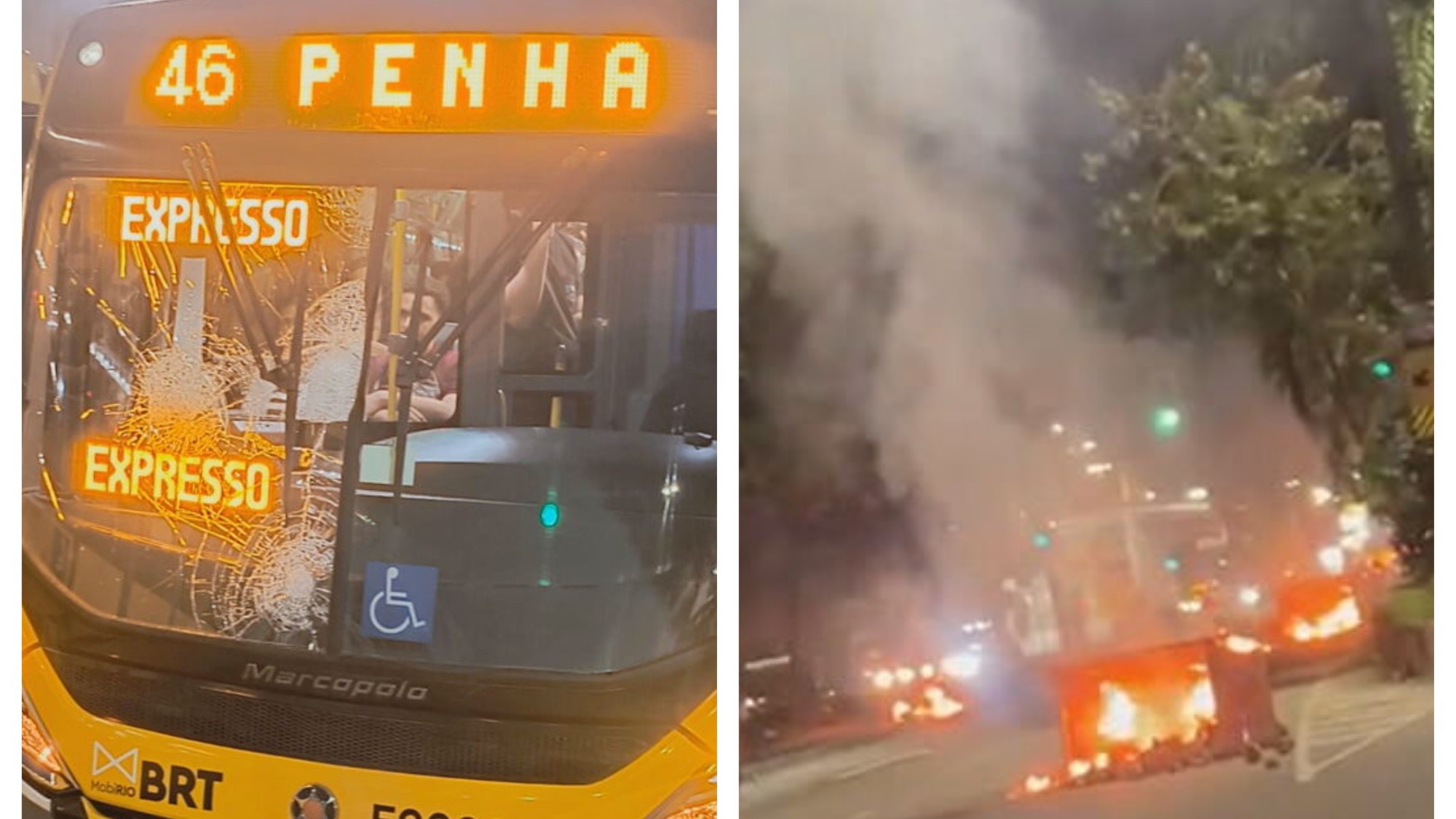
Criminals used two buses as barricades on Estrada dos Bandeirantes in Jacarepaguá, Rio de Janeiro's West Zone, on Friday evening, November 17th. This occurred after a confrontation with military police in the Vila Sapê community, Curicica. According to Rio Ônibus, the perpetrators stole the buses' keys and positioned them across the road to block traffic. Additionally, burning barricades were set up near the Vila Sapê BRT station, and articulated buses were also stoned. Police reported that officers from the 18th BPM (Jacarepaguá) were attacked by criminals during an operation in the community and returned fire. Two suspects were shot and taken to Hospital Municipal Lourenço Jorge, while a third man was arrested. Authorities also seized a pistol, a radio communicator, and an unquantified amount of drugs. In retaliation for the police operation, criminals set fire to objects to obstruct a section of Estrada dos Bandeirantes, prompting police mobilization to clear the road. Five bus lines had their routes impacted: 810 (Pontal x Taquara), SP810 (Vargem Grande x Taquara), 368 (Riocentro x Candelária), 954 (Recreio x Taquara), and 348 (Riocentro x Candelária). The two buses used as barricades were operating on lines 810 and 954. Mobi-Rio reported that traffic near the Vila Sapê station has since normalized, and bus intervals for lines 31, 35, 40, 41, and 46 were being regularized.
This incident highlights the persistent challenges of public security in urban areas, where criminal elements can disrupt essential services and infrastructure. The use of public transportation as barricades demonstrates a strategic tactic to impede law enforcement response and create diversions. From a systems perspective, such events underscore the complex interplay between community policing, criminal activity, and the resilience of urban transit networks. Future considerations may involve enhanced surveillance, rapid-response protocols for infrastructure disruption, and community engagement strategies to address the root causes of such conflicts. The long-term implications involve the potential for increased operational costs for transit authorities and the erosion of public confidence in safety, necessitating a multi-faceted approach to urban security and mobility.
AI-generated to prompt reflection — not editorial opinion, not advice, not a statement of fact. How this works.