Road Safety Group Demands Legal Reforms and Public Awareness Campaign
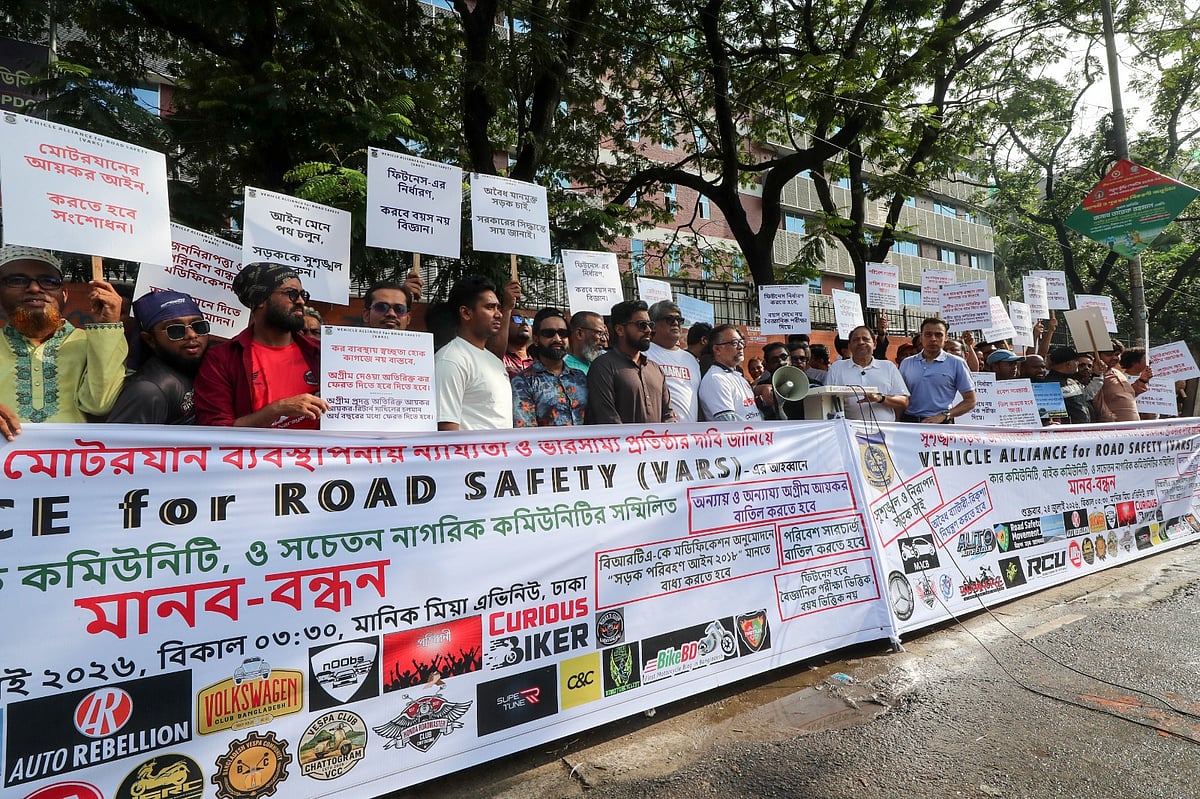
The Vehicle Alliance for Road Safety (VARAS) organized a human chain protest on Friday at Manik Mia Avenue in Dhaka, advocating for improved road discipline, increased public awareness, and amendments to several motor vehicle laws and policies. The event saw participation from various car and bike communities, as well as concerned citizens, according to a VARAS press release. The protest, held near the National Parliament building at 3:30 PM, also called for the government to implement its decision to remove illegal vehicles from the roads and regulate battery-powered rickshaws. VARAS further proposed that the government enlist public volunteers to help maintain road order. The organization urged for traffic law adherence among road users and the inclusion of traffic discipline education in school curricula. Key demands regarding motor vehicle management include amending the 'Income Tax Act, 2023' and 'Finance Act, 2026' to remove mandatory advance income tax on motor vehicles, and ensuring the refund of excess advance income tax paid. VARAS also called for the cancellation of the 'environmental surcharge' imposed on owners of multiple vehicles. They proposed that vehicle fitness assessments be based solely on scientific testing, rather than age, and that vehicle modifications be permitted if they do not compromise safety or the environment. Additionally, VARAS requested the Bangladesh Road Transport Authority (BRTA) to take necessary steps to implement approval processes under the 'Road Transport Act, 2018' and 'Road Transport Rules, 2022'.
This event highlights a citizen-led initiative to address systemic issues in road safety and motor vehicle regulation. The demands focus on legislative adjustments, enforcement of existing rules, and public education, indicating a multi-faceted approach to improving road conditions. The call for scientific fitness testing over age-based assessments and allowing modifications under certain conditions suggests a desire for more rational and technologically informed policy. The proposal for public-private collaboration in maintaining order points to a recognition of shared responsibility. Future considerations for policymakers might include integrating these demands into a comprehensive road safety strategy that leverages technology and data for enforcement and compliance, while ensuring that regulatory changes are equitable and do not disproportionately burden vehicle owners or hinder legitimate economic activity.
AI-generated to prompt reflection — not editorial opinion, not advice, not a statement of fact. How this works.