Robotics Startup Guangxiang Technology Secures Multi-Million Yuan in Seed Funding
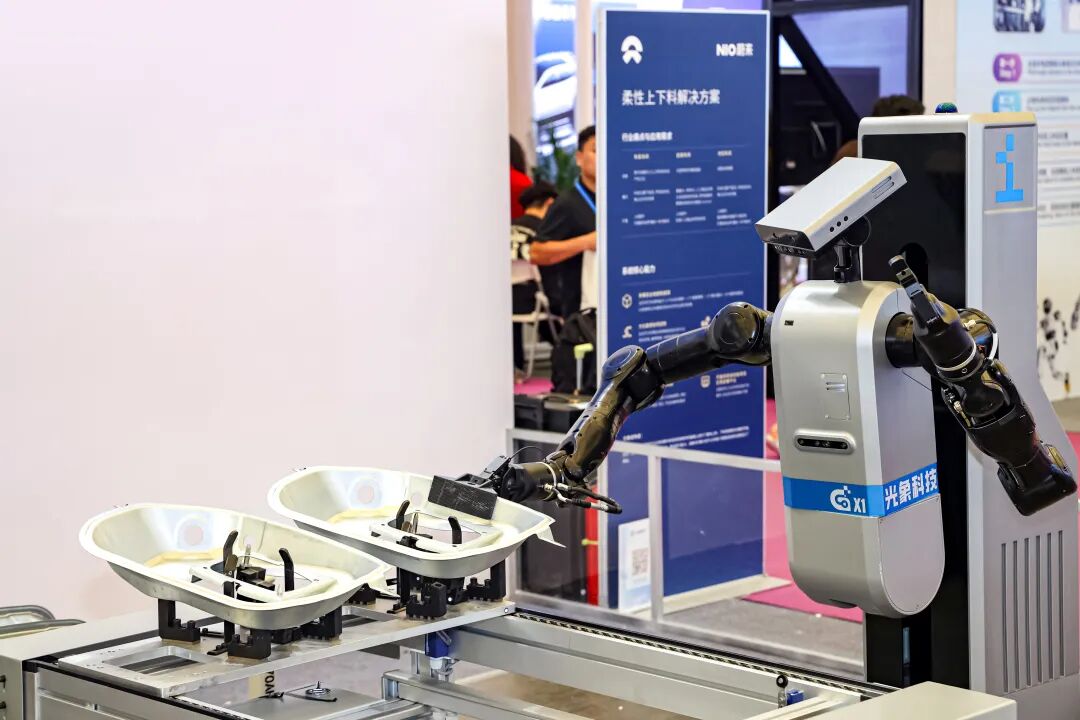
Guangxiang Technology, a China-based embodied intelligence company, has announced the completion of its seed funding round, accumulating several hundred million yuan. The latest investment saw significant participation from prominent financial and industrial investors including Zhuhai Science and Technology Industry Group, Xingzheng Capital, Songhe Capital, and others, with existing investors like Zero One Capital also increasing their stakes. The company plans to allocate these funds towards the research and development of its "physically-grounded foundation model" and to accelerate the commercial delivery of its embodied intelligent robots in industrial settings.
Founded in April 2025, Guangxiang Technology emerged from a joint initiative between Tsinghua University's School of Vehicle and Mobility Engineering and its School of Artificial Intelligence. The company's leadership includes CEO Zhang Tao, formerly head of perception engine development at Gaode, and co-founder Professor Li Shenbo, a renowned expert in reinforcement learning and autonomous driving. The broader team comprises experienced professionals from major tech and robotics firms such as Alibaba, Tencent, Huawei, KUKA, and Geek+. Guangxiang Technology is pursuing a distinct technological path, focusing on a "physically-grounded foundation model" that learns physical laws through interaction with the environment, rather than relying solely on imitation of human demonstrations or pixel-level predictions.
This approach is supported by a "three-in-one" technical system: the Phi-RL Matrix for advanced reinforcement learning, the Phi-Space for a comprehensive physics data asset, and the Phi-Arch platform for unified development. The company has already launched its industrial-grade embodied robot, the Phi-Bot X1, designed for automotive manufacturing. This robot has undergone extensive validation on automotive production lines, demonstrating high precision and efficiency in tasks like welding and material handling. Guangxiang Technology aims to address the remaining 30% of automation gaps in the automotive industry that current technologies cannot solve, such as hazardous welding operations and quality inspection tasks requiring flexible adjustments. The company intends to deepen its focus on the automotive sector before expanding to other industrial applications within three to five years.
Guangxiang Technology's substantial seed funding and its focus on a "physically-grounded foundation model" for embodied AI signal a strategic pivot towards more robust, interaction-based learning in robotics. This approach contrasts with imitation-learning methods, potentially offering greater adaptability and generalization in complex industrial environments. The company's emphasis on validating its Phi-Bot X1 robot in real-world automotive production lines, rather than solely relying on demonstrations, suggests a commitment to commercial viability. The automotive industry, as a demanding testbed for automation, presents both significant opportunities and challenges, particularly in addressing tasks that have historically eluded full automation due to their complexity or hazardous nature. The long-term success of this venture will likely hinge on the scalability of its "physically-grounded" model, the efficiency of its data-driven learning process, and its ability to integrate seamlessly into existing industrial workflows, potentially redefining human-robot collaboration in manufacturing.
AI-generated to prompt reflection — not editorial opinion, not advice, not a statement of fact. How this works.