Romanian F-16 intercepts drone for third consecutive day
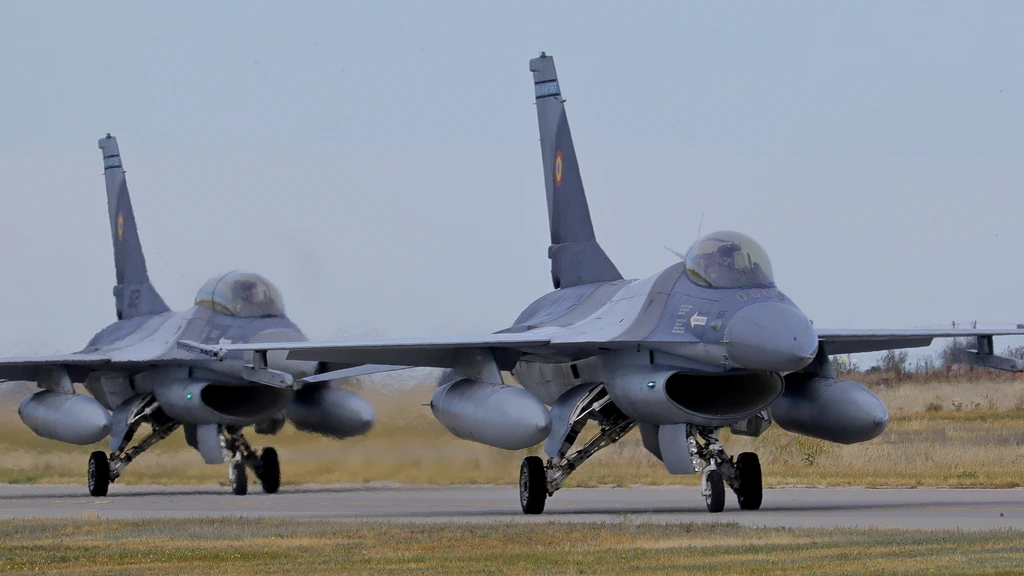
The Romanian Air Force successfully intercepted and shot down a drone with an F-16 fighter jet for the third day in a row. The incident occurred this morning over Romanian waters near the mouth of the Danube River, which forms the border between Ukraine and Romania. The origin of the drone is currently under investigation. President Nicusor Dan commended the Romanian pilots and ground crews for their professionalism and courage. A drone shot down on Friday was identified as a Shahed kamikaze drone, commonly used by Russia in attacks on Ukraine, according to Romanian research. The origin of the drone downed on Saturday remains under investigation.
President Dan stated that Russia's continued violations of Romanian airspace, which is also NATO and EU airspace, are unacceptable. This marks the third such incident in three consecutive days, with the first occurring on Friday. The latest incident took place near the city of Sulina. The Kremlin has not yet responded to Romania's accusations. Romania has experienced frequent airspace violations by drones throughout the four-year war.
Previously, in May, a Russian drone was reportedly responsible for hitting an apartment complex in Galati, though this was disputed by President Putin. Last month, Ukrainian naval drones landed in the Romanian port city of Constanta, with one detonating, an event Ukraine attributed to Russian interference. With ongoing Black Sea naval attacks between Russia and Ukraine, there is an increased risk of unintended or even targeted attacks against Romania, a NATO member bordering Ukraine and the Black Sea. Meanwhile, in Ukraine, Russian missile and drone strikes killed at least two people and injured eighteen across various cities, while Ukrainian shelling in Russian-occupied areas resulted in four deaths.
This series of drone interceptions highlights the escalating risks of spillover effects from the Russia-Ukraine conflict into neighboring NATO territories. Romania's proactive defense measures, while necessary for national security, underscore the challenges of maintaining airspace integrity in a volatile region. The repeated incursions, regardless of intent or origin, necessitate a careful calibration of responses to avoid unintended escalation. Future strategies will likely focus on enhanced surveillance, improved inter-alliance intelligence sharing, and clear protocols for managing airspace incursions to deter further violations and maintain regional stability within the broader geopolitical framework.
AI-generated to prompt reflection — not editorial opinion, not advice, not a statement of fact. How this works.