S Alam Group Accused of Siphoning Off Over $2 Billion Abroad
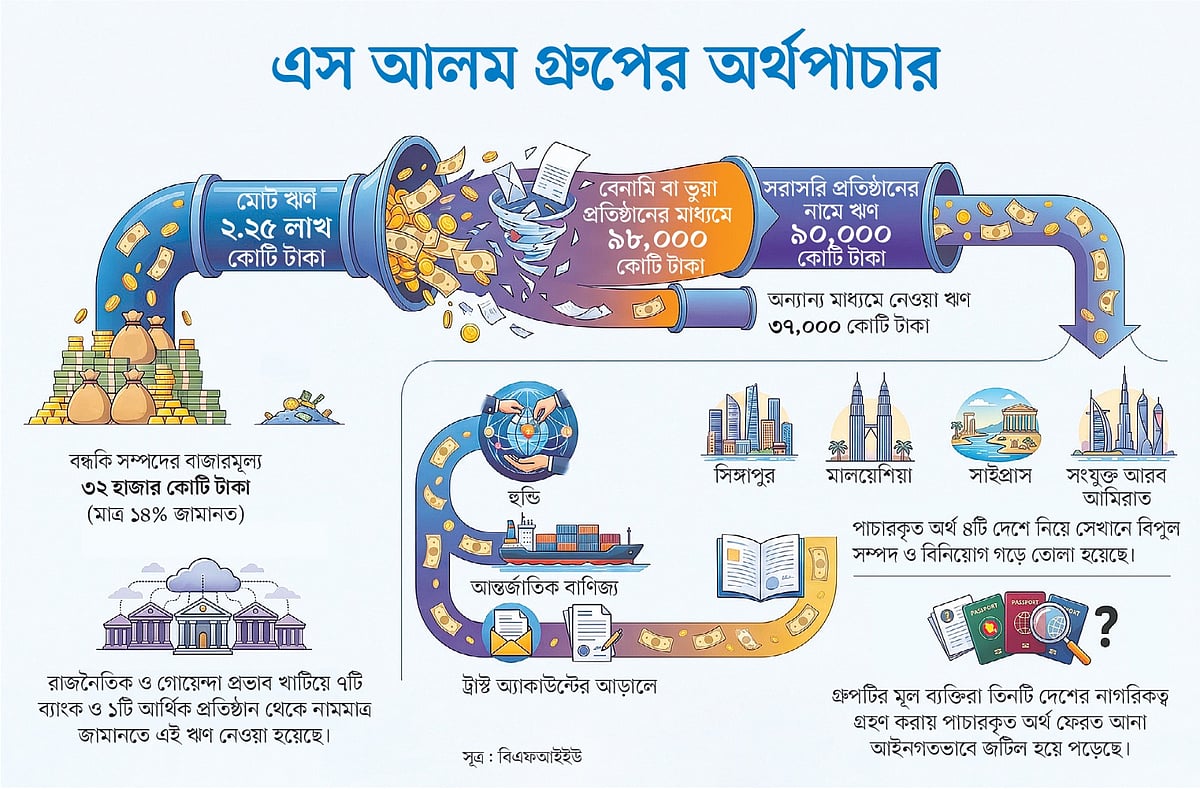
A report by Bangladesh's Financial Intelligence Unit (BFIU) alleges that the S Alam Group has siphoned off approximately 2.25 lakh crore Taka (over $2 billion USD) from the country's banking sector. The conglomerate allegedly gained control of seven banks and one financial institution by leveraging political influence and state intelligence agencies during the 15-year rule of the Awami League government. Without adhering to regulations, the group purportedly acquired these funds through nominal collateral, subsequently embezzling and transferring them abroad under various names. The BFIU's annual report for fiscal year 2024-25 details these allegations, using 'S Group' as a pseudonym in a case study, which was later confirmed by BFIU officials to refer to S Alam Group. The report characterizes this as an unprecedented and systemic failure within Bangladesh's banking history, involving loan fraud, misuse of bank funds, bond manipulation, abuse of public office, and manipulation of institutional controls. Funds were allegedly transferred through trust accounts, international trade, and informal channels like Hundi, with assets established in Singapore, Malaysia, Cyprus, and the UAE. Key individuals associated with the group have reportedly acquired citizenship in three different countries, complicating potential recovery efforts.
The BFIU report highlights significant systemic vulnerabilities within Bangladesh's financial sector, suggesting that a combination of regulatory loopholes, political influence, and a lack of robust oversight enabled the alleged large-scale financial irregularities. The alleged use of shell companies, nominal collateral, and informal remittance channels points to sophisticated methods of capital flight. The report's findings, if substantiated, indicate a critical need for enhanced corporate governance, stricter enforcement of banking regulations, and greater transparency in financial dealings to prevent future occurrences. The complexity introduced by dual or multiple citizenships among key figures underscores the challenges in cross-border financial crime investigation and asset recovery, necessitating stronger international cooperation frameworks. This situation raises questions about the efficacy of existing institutional checks and balances designed to safeguard the national economy from such alleged abuses of power and financial maneuvering.
AI-generated to prompt reflection — not editorial opinion, not advice, not a statement of fact. How this works.