São Paulo Reduces Water Pressure Reduction Period Despite Low Reservoir Levels
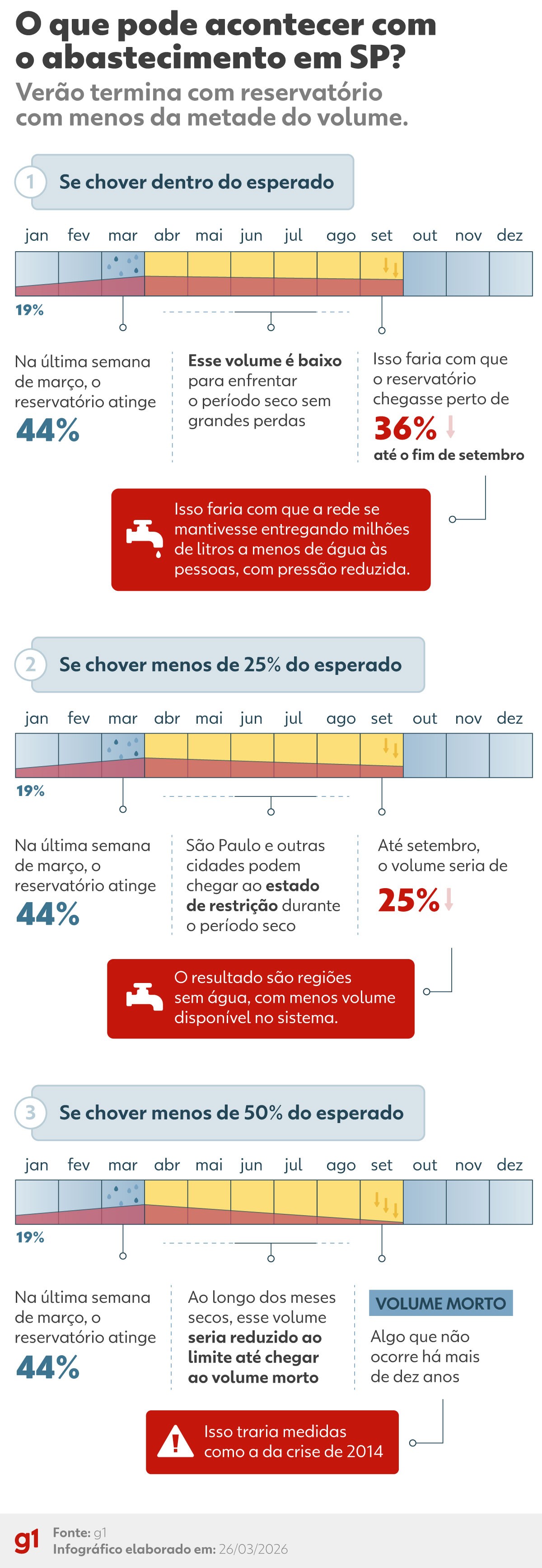
The government of São Paulo will shorten the daily period of reduced water pressure from 10 hours to 8 hours, despite the Cantareira System operating at its second-lowest level in a decade. This decision, deliberated by the State Regulatory Agency for Public Services (Arsesp) on Friday, August 31, will take effect 48 hours after publication. The "Nighttime Demand Management" (GDN) will now occur from 10 PM to 6 AM, starting in August. The state government justified this change by moving the Cantareira System from contingency band 3 to band 2, based on its water management methodology. Recent rainfall and inflows exceeding projections contributed to this improvement, with stored volume 2.69% above the forecast. Between July 20 and 26, the Cantareira region received 31.6 mm of rain, 177% more than predicted. In Extrema (MG), a key contributor to the Cantareira, 61.2 mm of rain fell, 144.3% of the monthly average. June rainfall was 103.2 mm, nearly double May's 53.5 mm, bringing the useful volume to 39.9%, above the projected 37.8%. However, the Cantareira System currently holds only 36.7% of its capacity, the second-worst level for this period in ten years, slightly above 2022's 36.3%. The state also cited the Nighttime Demand Management, implemented in August 2025, as saving 183 billion liters of water. Secretary of Environment, Infrastructure and Logistics, Natália Resende, noted that while inflows have improved, the historical storage levels remain low. She emphasized that São Paulo faces chronic water scarcity and stressed the importance of continued conscious water use regardless of the season. The state's band change does not affect the Cantareira System's operation as defined by the National Water Agency (ANA) and SP Águas, which allows Sabesp to extract up to 27 cubic meters per second.
The São Paulo government's decision to reduce water pressure management, despite critically low reservoir levels, presents a complex trade-off between immediate public convenience and long-term water security. While recent rainfall has improved inflow figures and moved the system to a less severe contingency band, the Cantareira System's overall storage remains historically low. This move suggests a potential divergence between short-term operational adjustments driven by marginal improvements and the systemic imperative for sustained water conservation in a region facing chronic scarcity. The government's emphasis on continued conscious consumption highlights an awareness of this underlying vulnerability. Future water management strategies will need to balance responsiveness to short-term meteorological fluctuations with robust, long-term planning that accounts for climate change impacts and population growth, ensuring that policy decisions do not inadvertently undermine resilience against future droughts.
AI-generated to prompt reflection — not editorial opinion, not advice, not a statement of fact. How this works.