Science Lecture Held on 'Elements', Non-Euclidean Geometry, and Relativity
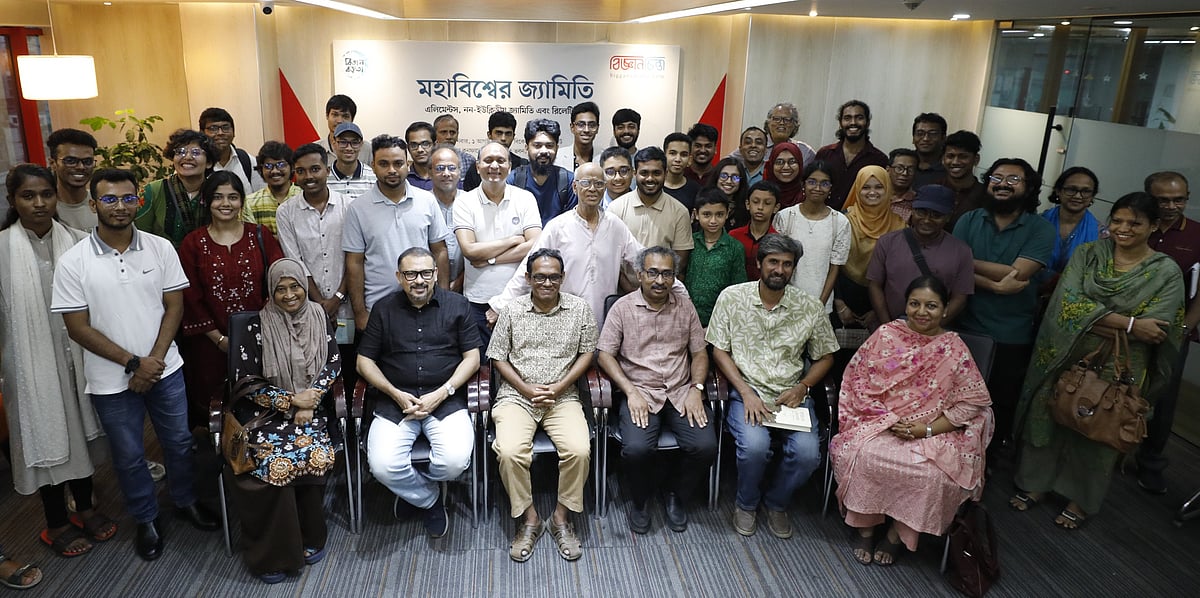
A science lecture titled 'Geometry of the Universe: Elements, Non-Euclidean Geometry, and Relativity' was organized by the popular science magazine 'Bigganchinta' on Saturday afternoon, August 1st. The event took place at the Progoty Bhaban in Karwan Bazar and continued until approximately 6 PM. Prominent speakers included author and science communicator Asif, Professor Farseem Mannan Mohammadi from the Electrical Engineering department at Bangladesh University of Engineering and Technology (BUET), and Safiq Islam, a teacher at Government Haraganga College. Asif discussed the significance of Euclid's 'Elements', highlighting its foundational role in mathematics and science, and how it influenced figures like Copernicus, Galileo, Newton, and Einstein. He detailed the book's structure, emphasizing how its 48 propositions in the first volume are built upon five postulates and five common notions, demonstrating the power of deriving extensive knowledge from basic principles. Professor Mohammadi elaborated on non-Euclidean geometry and relativity, discussing the historical context of 'Elements' and Euclid's role as a compiler of existing geometric knowledge. He noted that while the universe appears flat on a large scale based on modern observations, he expressed concern over the declining interest in fundamental mathematics research in Bangladesh, stressing the need to strengthen the environment for basic mathematical education and research to foster future mathematicians. The event also featured a Q&A session where attendees posed questions on topics ranging from unsolved scientific problems to the philosophical concept of a point, followed by a quiz competition with prizes for the winners. The lecture concluded with a group photo session and informal interactions.
This event highlights the enduring influence of foundational mathematical texts like Euclid's 'Elements' on scientific thought. The lecture's focus on geometry, relativity, and the need for robust basic research underscores a critical juncture for scientific education. As societies increasingly rely on advanced technological applications, the underlying theoretical frameworks require continuous nurturing. The organizers' stated goal of fostering scientific curiosity and logical thinking among young people is commendable. However, the expressed concern about declining interest in fundamental mathematics research points to a potential systemic challenge. Future progress in fields like AI and theoretical physics will depend on cultivating a generation capable of both abstract reasoning and innovative problem-solving, necessitating sustained investment in fundamental mathematical disciplines and research environments.
AI-generated to prompt reflection — not editorial opinion, not advice, not a statement of fact. How this works.