Scientists Observe Phase Coherence in Magnon Bose-Einstein Condensate
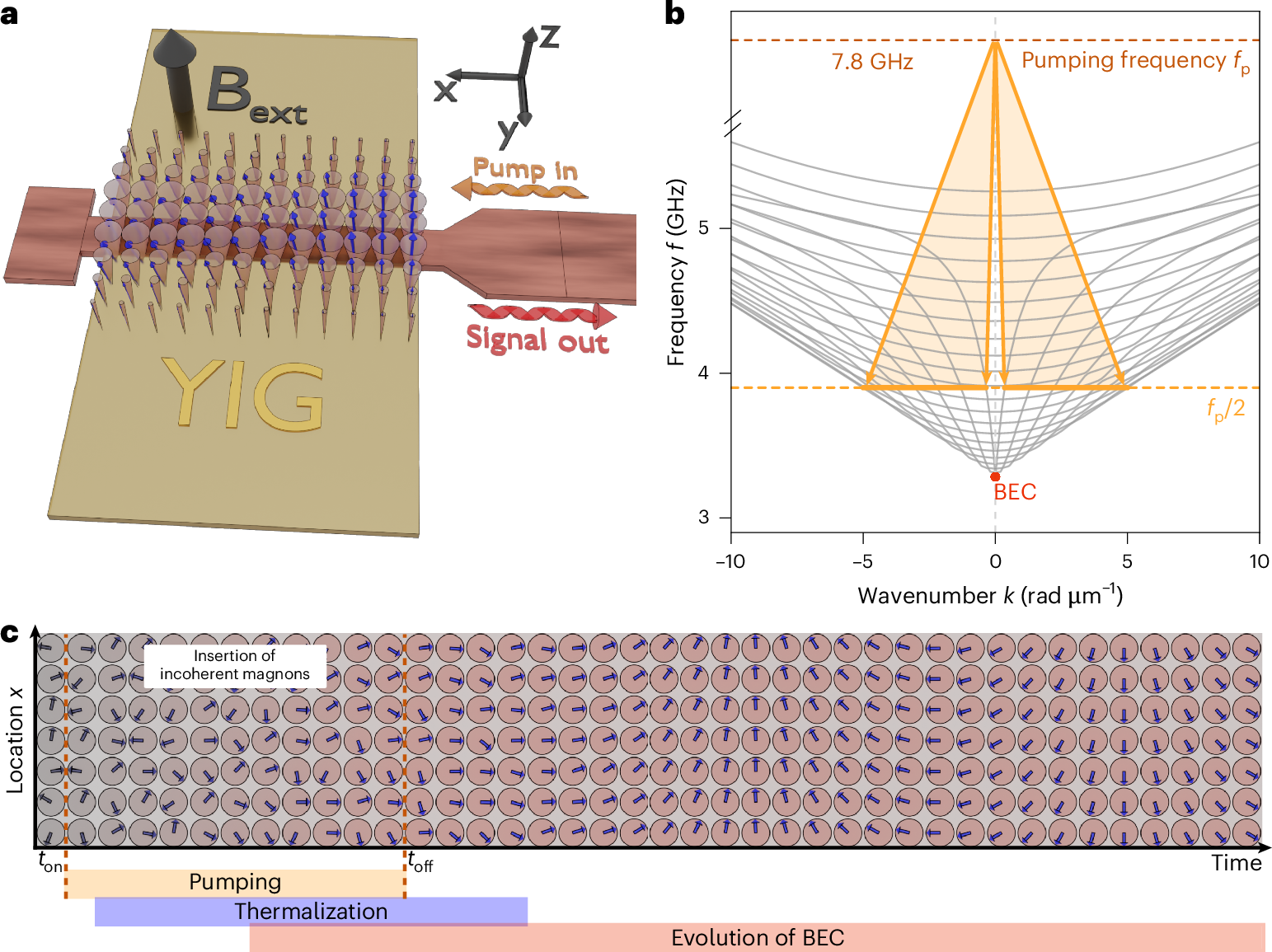
Researchers have successfully observed the emergence of phase coherence within a magnon Bose-Einstein condensate. This phenomenon marks a significant step in understanding and manipulating quantum states in condensed matter systems. The experiment involved creating a specific type of quantum state where magnons, which are quantized spin waves, behave collectively like a single entity. Achieving phase coherence means that these magnons are oscillating in unison, exhibiting a unified quantum wave function. This collective behavior is a hallmark of Bose-Einstein condensates, which are typically formed from atoms cooled to near absolute zero. The observation in magnons suggests that similar quantum phenomena can be realized in systems other than just atomic gases. This breakthrough could pave the way for new applications in quantum computing and spintronics, where the precise control of quantum states is crucial. Further research will focus on sustaining and controlling this phase coherence for longer durations and under different conditions. The team aims to explore the potential of magnon Bose-Einstein condensates for developing novel quantum technologies.
The observation of phase coherence in a magnon Bose-Einstein condensate represents a notable advancement in quantum physics, potentially broadening the scope of systems capable of exhibiting Bose-Einstein condensation. This finding could accelerate research into quantum information processing and novel electronic devices by demonstrating that collective quantum behaviors are not limited to traditional atomic systems. Understanding the conditions that foster and sustain this coherence will be key to harnessing its potential for future technologies, offering new avenues for manipulating quantum states beyond current paradigms. The long-term implications may involve developing more robust quantum computing architectures or highly sensitive magnetic field sensors, contingent on overcoming challenges in scalability and environmental stability.
AI-generated to prompt reflection — not editorial opinion, not advice, not a statement of fact. How this works.