Scientists Use Atomic Force Microscopy to Build Carbon Structures
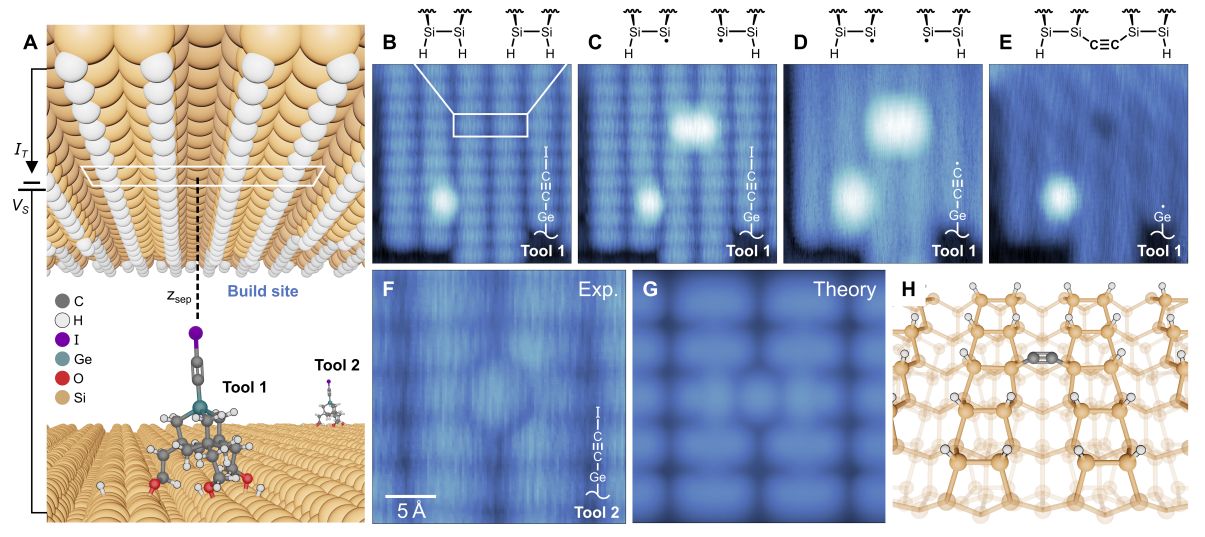
Researchers have developed a novel method for synthesizing atomic carbon structures by directly manipulating individual atoms. This technique bypasses traditional chemical synthesis, which typically involves combining various compounds in a reactive environment for self-assembly. Instead, the new approach utilizes an inverted-mode scanning tunneling microscope (STM) to precisely position and bond carbon atoms. This direct mechanical manipulation offers a fundamentally different pathway to creating complex atomic architectures. The process allows for unprecedented control over the placement of atoms, enabling the construction of structures that might be difficult or impossible to achieve through conventional chemical means. This breakthrough opens new possibilities in materials science and nanotechnology, potentially leading to the development of advanced materials with tailored properties. The ability to build structures atom by atom could revolutionize the design and fabrication of nanoscale devices and novel carbon-based materials.
This advancement in mechanosynthesis represents a significant departure from conventional chemical synthesis, offering direct atomic control over material construction. By employing an inverted-mode STM, scientists can bypass the limitations of self-assembly and reaction kinetics, enabling the creation of bespoke atomic structures. This precision engineering at the atomic scale could unlock novel material properties and functionalities, driving innovation in fields like quantum computing and advanced electronics. The long-term implications involve a potential paradigm shift towards bottom-up manufacturing, where materials are built atom by atom, offering greater efficiency and reduced waste compared to top-down or bulk chemical methods. Future research will likely focus on scaling this technique and exploring its application to a wider range of elements and complex molecular designs.
AI-generated to prompt reflection — not editorial opinion, not advice, not a statement of fact. How this works.