Security Questions Emerge Over Trump's Gifted Air Force One
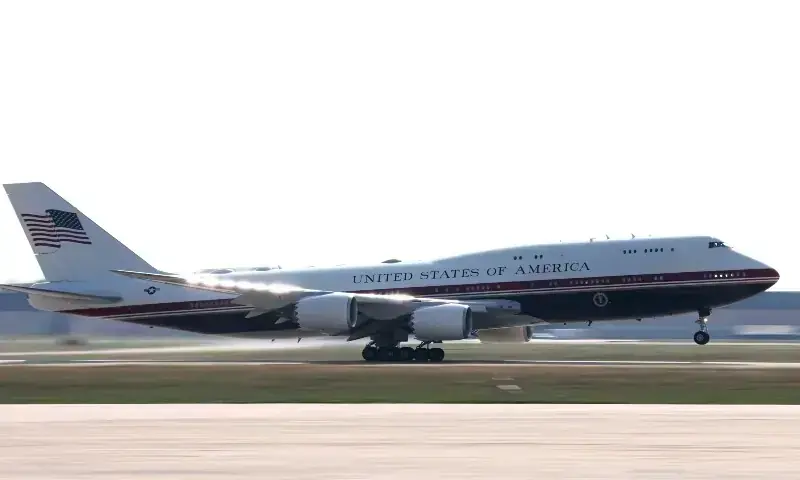
President Donald Trump's use of a newly gifted Boeing 747-8 aircraft, referred to as "Scare Force One," has sparked security concerns. The Qatari-donated jet, retrofitted for the president, was used for a trip to Ankara, Turkey, before Trump abruptly switched to an older, presumably more secure, aircraft for the flight to a British airbase. This decision, reportedly advised by the Secret Service, occurred amid heightened tensions with Iran, which borders Turkey. Journalists on the older plane also reported being instructed to keep window blinds down, a measure typically reserved for war zones. While Trump denied security issues, he later alluded to potential dangers from "sleazebags" and alleged Iranian assassination attempts. The New York Times, which reported the new plane lacked anti-missile defenses and other countermeasures present on older Air Force Ones, stated its journalists received subpoenas following their report. The White House, through Communications Director Steven Cheung, defended the new aircraft as state-of-the-art with high-level security protocols, asserting that "every tool at our disposal" is used to address threats, including "distraction and misdirection." The older Air Force Ones are known to possess sophisticated jamming and countermeasure systems, whereas the Qatari jet's defensive capabilities are unclear, and it visibly lacks some specialized external equipment. The US Air Force has acknowledged making compromises on less commonly used mission sets during retrofitting to expedite its service. Senate Democrats have formally questioned the US Air Force about "real national security concerns" regarding the Qatari plane. Former security officials have expressed skepticism about retrofitted jets matching the capabilities of purpose-built Air Force One aircraft. The Qatari jet is intended as a temporary solution until two new Boeing Air Force Ones are delivered later this decade, after which it is slated for donation to Trump's presidential library. The acceptance of such a valuable gift from a foreign power has also raised ethical questions.
The situation surrounding President Trump's use of a gifted aircraft highlights a tension between presidential security imperatives and the optics of foreign influence and resource management. The decision to switch aircraft, coupled with subsequent legal actions against journalists reporting on the matter, raises questions about transparency and the potential for information control. From a systems perspective, the reliance on a retrofitted foreign donation for a critical national security asset like Air Force One introduces vulnerabilities not present in purpose-built presidential aircraft, which are designed from the ground up with specific defensive and operational requirements. This event underscores the complex interplay of geopolitical relationships, domestic political messaging, and the practical challenges of maintaining state-of-the-art security infrastructure in the face of evolving threats and budgetary considerations. The long-term implications involve setting precedents for presidential asset acquisition and the potential for foreign entities to leverage such gifts for diplomatic or economic advantage.
AI-generated to prompt reflection — not editorial opinion, not advice, not a statement of fact. How this works.