Senior Lawyer Seeks Protection for Key Provisions of 15th Amendment, Including Judicial Council
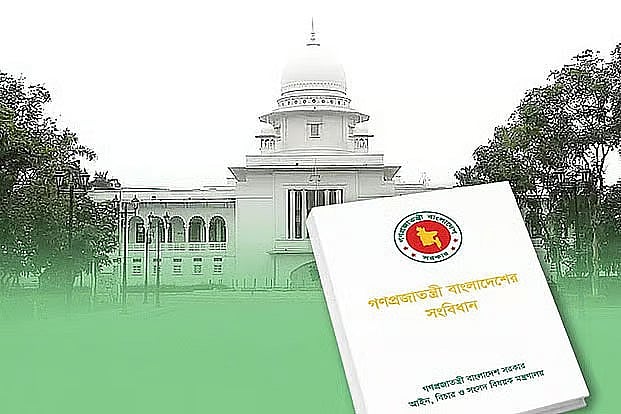
Senior Supreme Court lawyer Sharif Bhuiyan has requested that three specific provisions of the 15th Amendment to the Constitution not be declared unconstitutional. Bhuiyan argued that while the 15th Amendment was passed through a non-transparent process, its complete annulment could create problems or vacuums in certain areas, most notably concerning the Supreme Judicial Council. He made this plea during the hearing of appeals against the High Court's verdict on the 15th Amendment, which introduced significant changes including the abolition of the caretaker government system. The Appellate Division, led by Chief Justice Joynul Abedin, has set another date for the hearing. Three appeals have been filed against the High Court's ruling on the 15th Amendment: one by four individuals including Badiul Alam Majumdar, editor of Citizens for Good Governance (Sujan), another by Md. Mofazzal Hossain, and a third by Mia Ghulam Parwar, Secretary-General of Jamaat-e-Islami. Bhuiyan explained that the complete invalidation of the 15th Amendment could lead to the removal of the Supreme Judicial Council, a body initially established through military ordinances and later incorporated into the constitution via the 5th Amendment. Although the 5th Amendment was later declared illegal, the Supreme Judicial Council was reinstated through the 15th Amendment. Therefore, its removal due to the annulment of the entire 15th Amendment could cause systemic issues. Bhuiyan specifically sought protection for Articles 31, 36, and 41 of the 15th Amendment, which deal with judicial tenure, the Supreme Judicial Council, and the continuation of certain military ordinance provisions, respectively, stating that their invalidation would create a void, while other parts could be declared unconstitutional without issue. Representing Jamaat-e-Islami, senior lawyer Mohammad Shishir Monir argued that the 15th Amendment essentially rewrote the constitution, introducing fundamental principles of state policy. He contended that matters of policy and fundamental principles should be left to Parliament's discretion after thorough debate, and judicial intervention in these areas would undermine legislative power. Monir urged the court to leave policy decisions to Parliament, except for those that fundamentally conflict with the constitution's basic structure, such as the abolition of the caretaker government system, which he argued is essential for democracy. Other parties, including the Human Rights Support Society and interveners, also presented their arguments.
The legal challenge to the 15th Amendment highlights a recurring tension in Bangladesh's constitutional history between judicial review and parliamentary sovereignty, particularly concerning fundamental principles of governance. The arguments presented suggest a strategic approach to constitutional litigation, seeking to preserve specific institutional mechanisms like the Supreme Judicial Council, which has a complex history of incorporation and removal through various constitutional changes and judicial pronouncements. This legal maneuvering reflects an effort to mitigate potential systemic instability arising from broad constitutional invalidations. The debate over whether policy matters, even those impacting democratic principles like the caretaker government system, should be subject to judicial veto or left to legislative prerogative raises questions about the optimal balance of power in a democracy. Looking ahead, the judiciary's role in interpreting and potentially limiting constitutional amendments, especially those that significantly alter the state's foundational principles, will continue to shape the nation's governance framework and its adherence to democratic norms.
AI-generated to prompt reflection — not editorial opinion, not advice, not a statement of fact. How this works.