Shark 'steals' tuna from fisherman's line in Fernando de Noronha
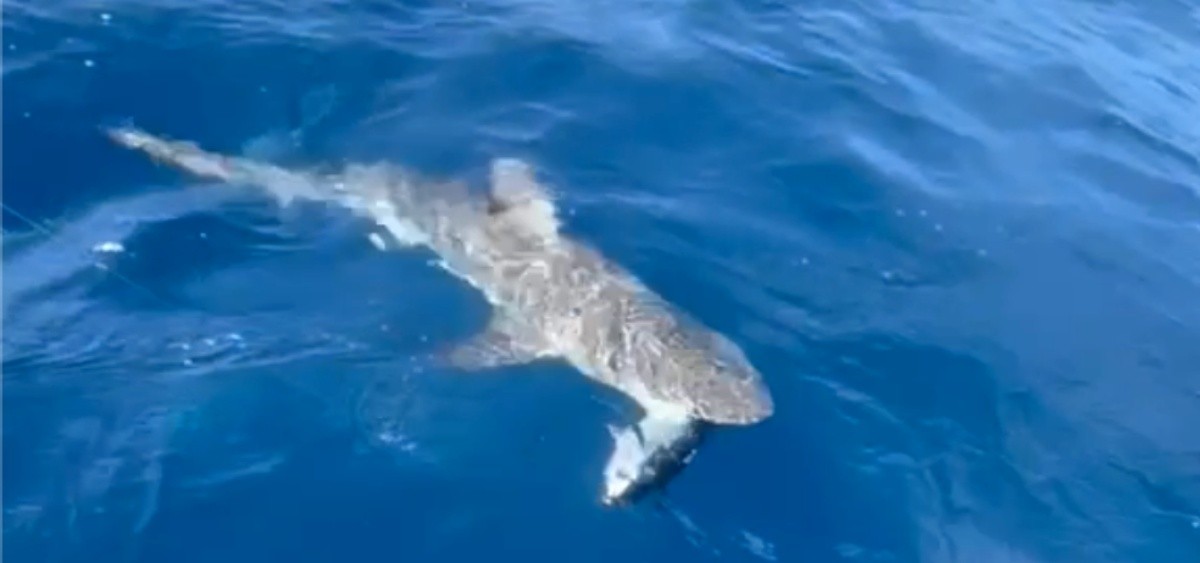
A fisherman captured a striking video showing a shark taking a tuna that had already been hooked off the coast of Fernando de Noronha, Brazil. The footage, recorded on Monday, May 13, by Ian Chacal, depicts the shark's swift action just moments before the fish could be brought aboard. According to local fishermen, this type of incident, where sharks intercept catches, has become increasingly common in the island's fishing grounds. The video clearly shows two sharks approaching the boat, with one successfully seizing the tuna from the fishing line. Chacal stated that approximately eight out of every ten fish caught are taken by sharks, making fishing increasingly challenging. He noted that while these events happen rapidly and are difficult to document, he managed to record this particular instance. A marine biologist, Mariana Rêgo from the Federal Rural University of Pernambuco (UFRPE), identified the shark species as a blacktip shark (Carcharhinus falciformes). This species is also found in the Saint Peter and Saint Paul Archipelago, approximately 620 kilometers away, where fishermen also experience similar predation. UFRPE researchers are collaborating with the Noronhense Fishermen's Association (Anpesca) to develop guidance for fishermen aimed at mitigating fish losses to sharks. Separately, a study by the Rotador Dolphin Project has observed a decrease in dolphin presence in Fernando de Noronha, with shark predation being investigated as a potential contributing factor. To address the growing concerns regarding shark activity, the Fernando de Noronha District Council has scheduled a meeting for August 4th to discuss the increased presence of sharks, safety measures, monitoring, and potential management strategies.
The increased interaction between sharks and fishing activities in Fernando de Noronha highlights a complex ecological dynamic. As human fishing efforts expand, they inevitably intersect with natural predator-prey relationships, leading to resource competition. The identification of the blacktip shark and its presence in multiple archipelagos suggests a broader regional pattern of shark behavior influenced by available food sources. The collaborative efforts between researchers and local fishermen to find mitigation strategies reflect an adaptive approach to coexistence. Future management will likely need to balance the economic needs of the fishing community with the conservation of marine ecosystems and the role of apex predators like sharks. Understanding the drivers behind shark population changes and their foraging patterns will be crucial for developing sustainable solutions that acknowledge both ecological integrity and human livelihoods in the coming decade.
AI-generated to prompt reflection — not editorial opinion, not advice, not a statement of fact. How this works.