Six New Open-Weight AI Models Released This Week
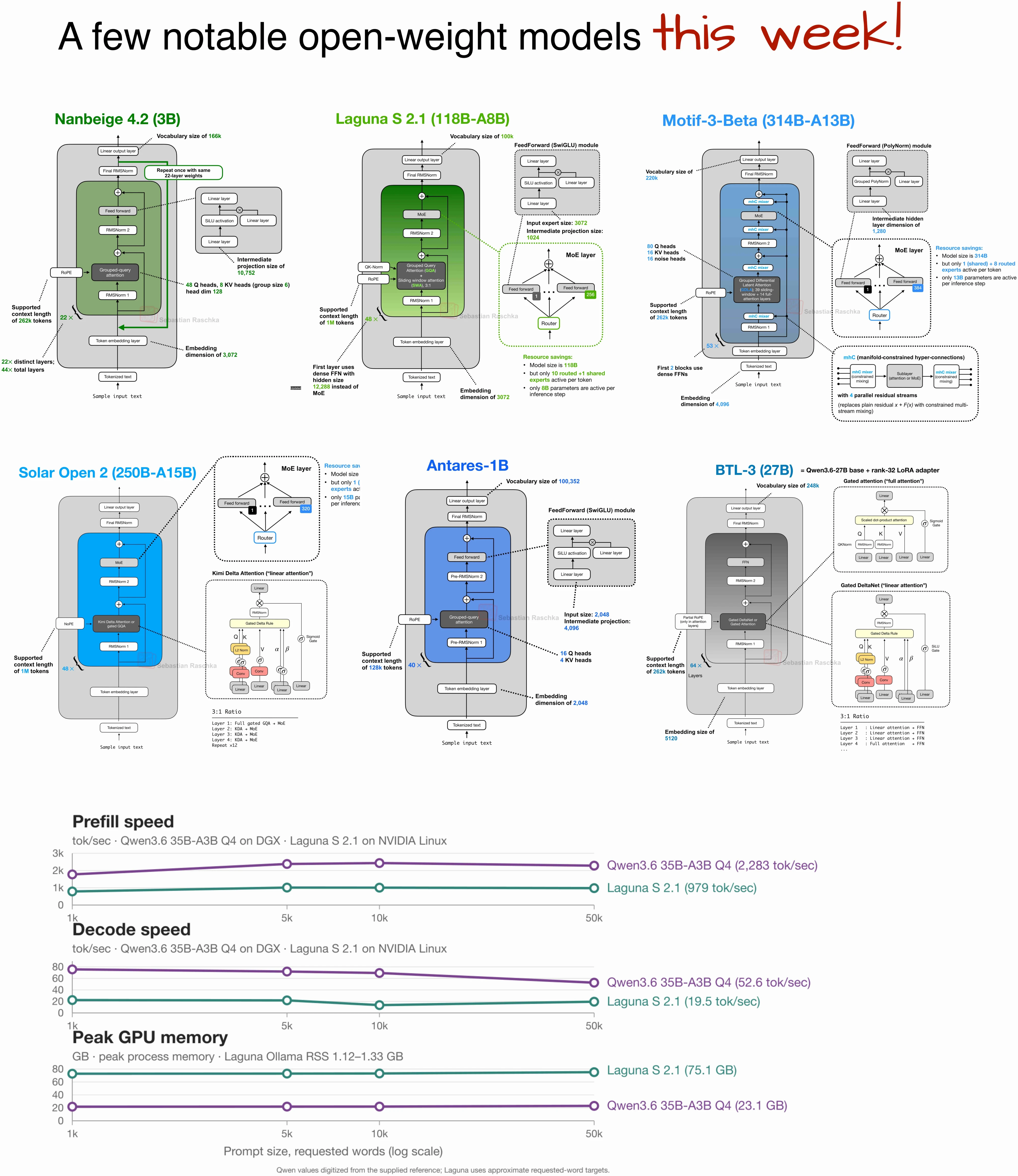
Several new open-weight artificial intelligence models have been introduced this week, offering researchers and developers expanded options for experimentation and application. Among the notable releases are Nanbeige 4.2, Laguna S 2.1, Motif-3-Beta, Solar Open 2, Antares 1B, and BTL-3. These models represent advancements in various architectural approaches within the rapidly evolving field of large language models. The availability of open-weight models is crucial for fostering innovation and democratizing access to cutting-edge AI technology. Developers can leverage these architectures to build new applications, fine-tune existing systems, and contribute to the broader AI research community. The diversity in model sizes and capabilities suggests a growing ecosystem catering to different computational resources and performance requirements. This trend underscores the ongoing commitment to open-source development in AI, promoting transparency and collaborative progress.
The proliferation of open-weight models signifies a healthy trend towards democratization and accelerated innovation within the AI landscape. By releasing these architectures, organizations are fostering a collaborative environment where researchers can build upon existing work, identify potential improvements, and adapt models to diverse use cases. This open approach can lead to faster identification of biases and vulnerabilities, as a wider community scrutinizes the underlying code and performance. Looking ahead, the increasing availability of such models may challenge the dominance of proprietary systems, potentially driving down costs and increasing accessibility for smaller enterprises and academic institutions. The challenge lies in ensuring robust documentation and community support to effectively onboard new users and maintain the integrity of these open-source projects.
AI-generated to prompt reflection — not editorial opinion, not advice, not a statement of fact. How this works.