Small plane crashed minutes after takeoff in Campo Grande, killing researcher and pilot
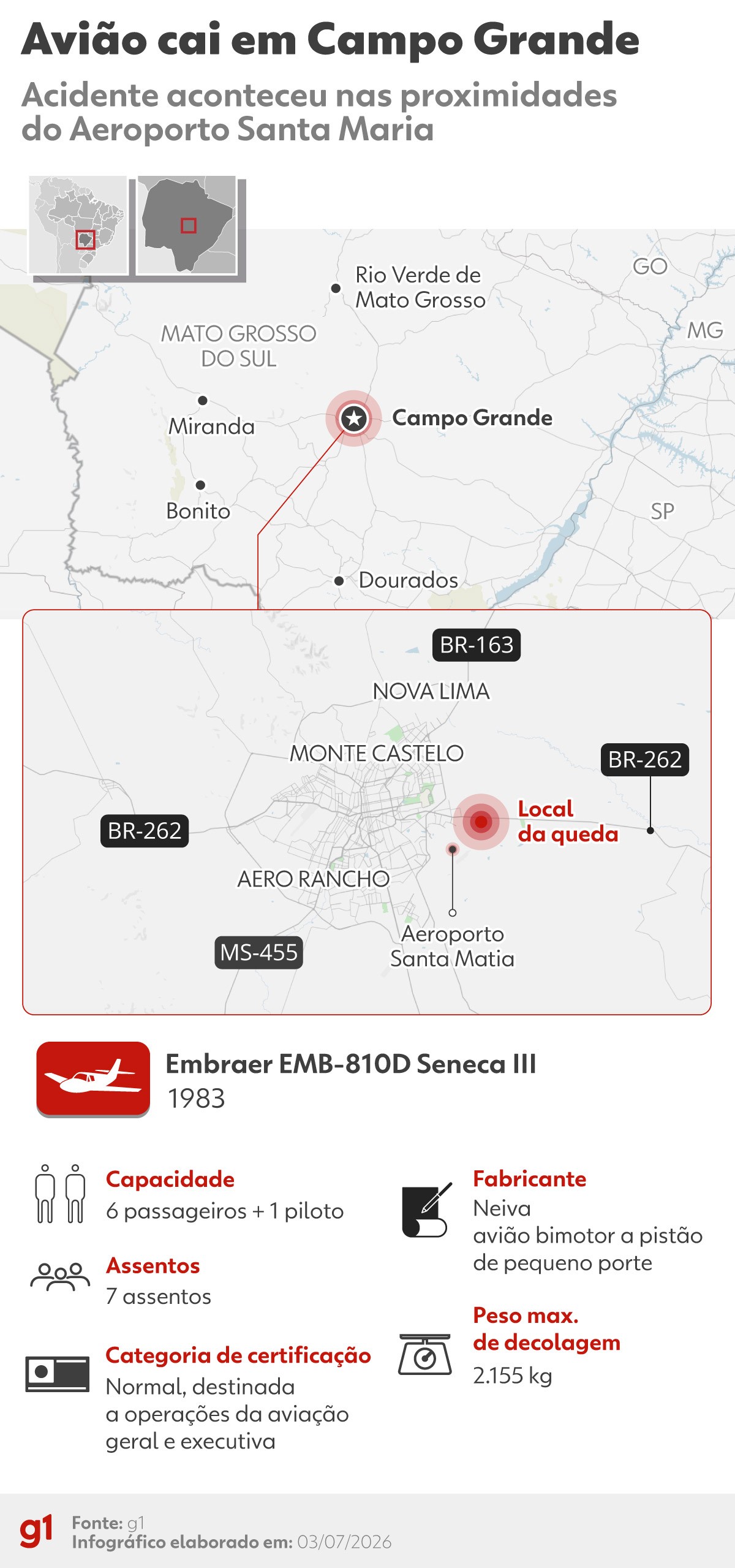
A small aircraft crashed just five minutes after takeoff in Campo Grande, Brazil, resulting in the deaths of German researcher Lydia Möcklinghoff and pilot Henrique Martin. The accident occurred around 6:30 AM on Friday, July 3, 2026, near the Santa Maria Airport. Authorities are investigating dense fog present that morning as a primary contributing factor, potentially causing spatial disorientation for the pilot. The Civil Police delegate, Sam Suzumura, stated that the adverse weather conditions likely led to the crash, though mechanical aspects of the EMB-810D aircraft will also be examined. The Center for Investigation and Prevention of Aeronautical Accidents (Cenipa) is expected to arrive on Saturday, July 4, to assist in the investigation. The aircraft, a 1983 Neiva EMB-810D bimotor, is certified for general and executive aviation and is authorized for air taxi services. Lydia Möcklinghoff was an internationally recognized zoologist, ecologist, and science communicator known for her extensive research on the giant anteater in the Pantanal region of Mato Grosso do Sul. Her book, "Ich glaub, mein Puma pfeift: Als Forscherin im reichsten Tierparadies der Welt," detailing her experiences researching anteaters, was found among the wreckage. The aircraft belongs to Amapil Taxi Aéreo, a company with over 52 years of operation, which expressed deep regret and pledged full cooperation with the investigation. The company emphasized its commitment to safety and technical rigor.
The tragic loss of life in this aviation incident underscores the critical interplay between human factors and environmental conditions in flight safety. While the investigation will meticulously examine mechanical and operational aspects, the preliminary focus on dense fog and potential pilot disorientation highlights the inherent risks of general aviation, particularly in challenging weather. This event prompts reflection on the adequacy of real-time weather data accessibility and pilot training protocols for low-visibility approaches and departures. The involvement of Cenipa signifies a commitment to a thorough, evidence-based understanding of the causal chain, aiming to prevent future occurrences through systemic improvements rather than assigning blame. Future aviation safety frameworks will likely integrate more advanced AI-driven predictive weather analysis and automated decision support systems to mitigate risks associated with human perception limitations in adverse conditions.
AI-generated to prompt reflection — not editorial opinion, not advice, not a statement of fact. How this works.