Space Telescope Swarms Could Image Exoplanets With New 'Smart Ruler' Technology
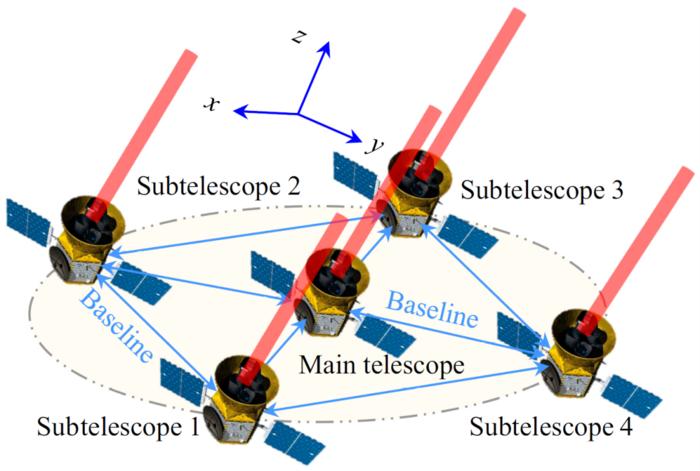
Researchers from Xidian University and the Beijing Institute of Control Engineering have developed a novel system to enable swarms of space telescopes to image exoplanets. Direct imaging of exoplanets is currently limited by the size of mirrors that can fit within rocket fairings, unless telescopes are placed extremely far from Earth. A promising alternative is interferometry, which involves multiple smaller satellites precisely coordinating to function as a single, massive mirror. However, building such systems presents significant technical challenges. The new paper, published in Space: Science & Technology, introduces a 'smart ruler' concept that addresses these difficulties. This technology aims to control and calibrate a free-floating interferometer, overcoming the complexities of precisely aligning and maintaining the formation of multiple spacecraft. This advancement represents a significant step forward in making large-scale space interferometry feasible for detailed exoplanetary observation.
The development of a 'smart ruler' system for controlling free-floating space interferometers addresses a critical engineering bottleneck in exoplanet imaging. By enabling precise calibration and coordination of multiple smaller satellites, this technology bypasses the physical limitations of launching single, monolithic mirrors of sufficient size. This approach aligns with a broader trend of distributed systems in space, leveraging modularity and swarm intelligence to achieve capabilities beyond what single, larger platforms can offer. The long-term implications include potentially democratizing exoplanetary science by reducing launch constraints and enabling more frequent, cost-effective missions. Future research may focus on the robustness of such systems against environmental perturbations and the scalability to even larger formations for enhanced observational resolution.
AI-generated to prompt reflection — not editorial opinion, not advice, not a statement of fact. How this works.