SpaceX Rocket Stage to Crash into Moon on August 5th
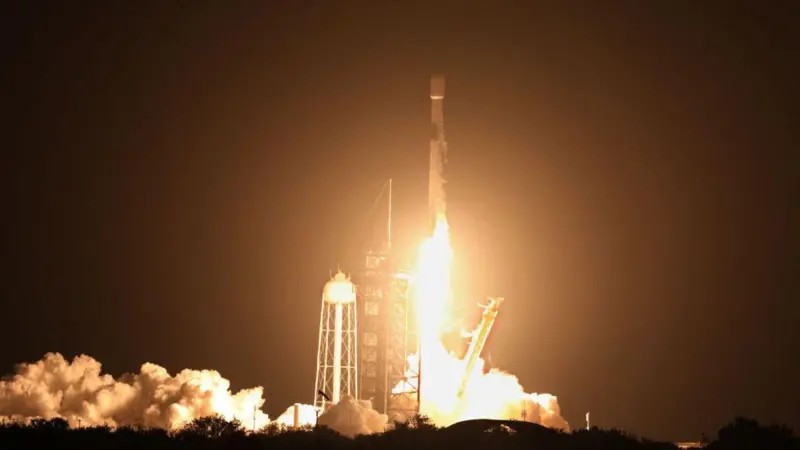
A spent SpaceX Falcon 9 rocket upper stage is predicted to impact the Moon on Wednesday, August 5th, at approximately 3:35 AM Brasília time. The object, roughly the size of a five-story building and weighing at least 4,000 kg, is traveling at about 2.43 kilometers per second. This event marks another instance of human-made debris colliding with the lunar surface, which has been naturally bombarded by asteroids and meteors for millions of years. The impact is expected to occur near the Einstein crater, creating a new crater over 17 meters in diameter. While not visible to the naked eye from Earth, sophisticated telescopes may detect a flash from the impact site. Scientists anticipate this collision will generate a dust cloud reaching heights of 50 km or more. The absence of an atmosphere on the Moon means the impact will be more dramatic than a similar explosion on Earth, with millions of kilograms of debris potentially ejected into space. This uncontrolled collision, noted by independent astronomers using public data, is considered accidental. NASA stated there is no danger to Earth and will continue tracking the rocket for training purposes, later observing the impact site for scientific research. The event presents a unique educational opportunity for astronomers, both professional and amateur, to study lunar impacts. By observing the dust plume's height and dispersion, scientists aim to refine their models of lunar impacts and potentially gain insights into subsurface lunar material. This incident also serves as a stark reminder of the growing problem of space debris. The European Space Agency estimates there are approximately 54,000 objects larger than 10 cm orbiting Earth, with humanity having launched around 17,000 tons of material into space since 1957. In 2022, the upper stage of China's Long March rocket also impacted the far side of the Moon.
This event highlights the increasing challenge of managing space debris. While this particular SpaceX rocket stage's trajectory was an accidental consequence of mission design, it underscores the long-term implications of leaving spent hardware in orbit. The Moon's lack of atmosphere and geological activity means impacts are preserved, creating a historical record of celestial and human activity. This uncontrolled collision, though scientifically valuable for studying impact dynamics and lunar subsurface composition, also serves as a tangible demonstration of the growing volume of human-made objects in near-Earth space and beyond. Future space exploration and utilization will necessitate more robust international frameworks for debris mitigation and responsible disposal of spacecraft components to prevent unintended consequences and preserve celestial bodies for scientific study and potential future use.
AI-generated to prompt reflection — not editorial opinion, not advice, not a statement of fact. How this works.
