SpaceX Starship 13 Achieves Best Launch Results to Date
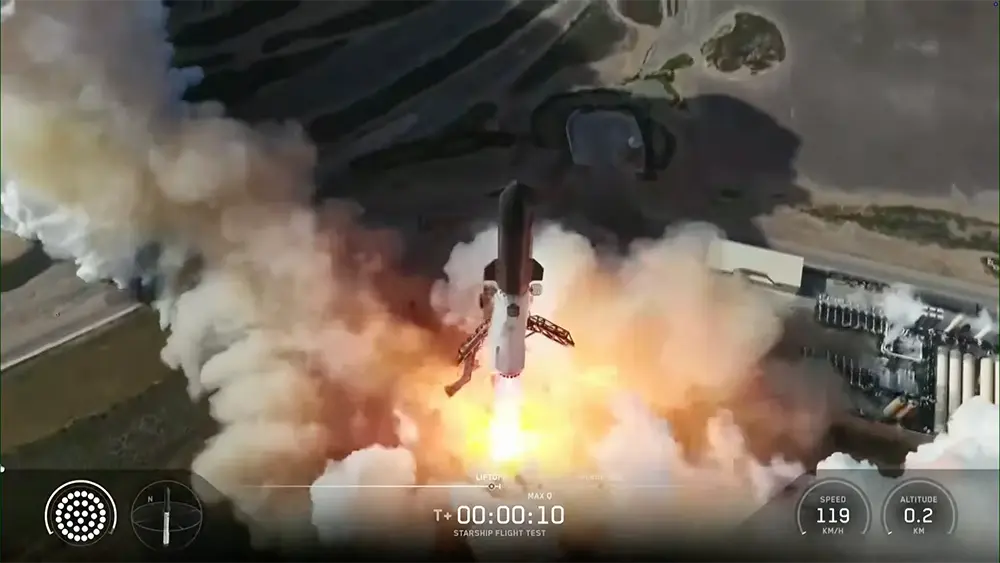
SpaceX successfully launched its Starship 13 rocket early this morning, marking the most successful flight of this vehicle to date. The mission aimed for the Booster 20 (first stage) to land in the Gulf of Mexico after separation, while the Starship 40 (second stage) would ascend to a suborbital trajectory. During this phase, the plan was to deploy twenty Starlink v3 satellites, ignite one of its Raptor engines, and execute a soft landing in the Indian Ocean.
Most objectives were met, with the Starship 40 performing flawlessly and remaining afloat for hours after landing, a first for the vehicle. However, the Booster 20's landing was less smooth than anticipated due to some engine failures. The deployment of Starlink satellites is crucial for SpaceX's future plans, as launching them via Starship is more cost-effective per unit and allows for greater payload capacity than using a Falcon 9. The successful ignition of the Raptor engine on the second stage was also vital, demonstrating the capability needed for future orbital insertions and potential return to base, rather than becoming space debris.
Elon Musk indicated that, pending data analysis, SpaceX will attempt to recover the second stage of Starship 14, likely Starship 41, by catching it with the launch tower's 'chopsticks.' The recovery plan for the first stage of that mission remains uncertain, pending an investigation into why all planned engines did not ignite, as a tower landing carries different risks than a sea landing. Despite the remaining challenges, including achieving orbit, satellite deployment, and full reusability, this launch represents a significant step forward for Starship's development, though orbital refueling capabilities are still needed for missions like NASA's Artemis IV to the Moon.
This launch represents a significant iterative improvement in SpaceX's Starship program, moving closer to its ambitious goals of cost-effective satellite deployment and eventual orbital operations. The successful suborbital flight and extended floatation of the second stage demonstrate progress in vehicle integrity and reusability potential. However, the partial failure in the first stage's landing highlights the persistent engineering challenges in achieving fully controlled, propulsive landings for large boosters. Future recovery attempts, particularly the proposed 'chopstick' catch, introduce new complexities and risks that will require rigorous risk assessment and mitigation strategies. The program's trajectory suggests a methodical, albeit high-stakes, approach to developing a fully reusable super heavy-lift launch system, essential for future space infrastructure and exploration endeavors.
AI-generated to prompt reflection — not editorial opinion, not advice, not a statement of fact. How this works.