SpaceX Starship's Cost Efficiency Could Revolutionize Space AI
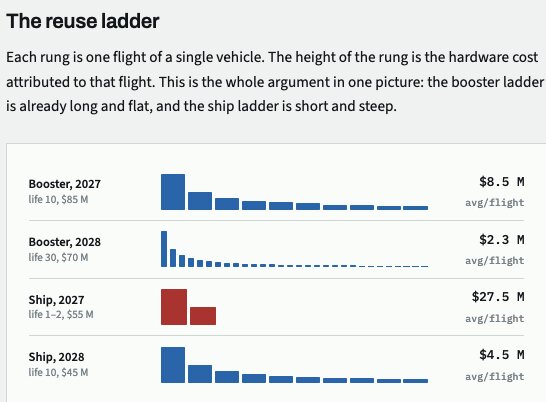
A new quantitative model suggests that SpaceX's Starship vehicle could significantly reduce the cost per kilogram for space missions, potentially enabling advancements in space-based artificial intelligence. The model analyzes how Starship's cost-effectiveness improves with increased booster and ship lifespan, as well as larger payload capacities. Specifically, it projects cost reductions as booster flights increase from 5 to 30 and ship flights from 1 to 10. Furthermore, the analysis indicates that the final flight of any given Starship vehicle would represent the cheapest kilogram of payload delivered within the entire system. This projected cost efficiency is expected to be a key factor as Starship prepares for wider deployment, potentially by 2027, making ambitious space AI projects more economically feasible.
The projected cost reductions for Starship missions, driven by reusability and increased payload capacity, could fundamentally alter the economic landscape of space exploration and development. This economic shift may accelerate the feasibility of large-scale space-based AI applications, such as advanced sensor networks, orbital data processing centers, or even space-based manufacturing. The model's focus on the declining cost per kilogram, particularly on the final flight of a vehicle, highlights a potential system optimization strategy. This could incentivize mission architectures that maximize utilization before retirement, influencing future design and operational considerations for reusable space systems. The challenge will be to translate this cost advantage into tangible advancements in space AI capabilities, ensuring that the technological and scientific benefits align with the economic efficiencies.
AI-generated to prompt reflection — not editorial opinion, not advice, not a statement of fact. How this works.