Spain's A400M firefighting kits: Prototypes exist, but operational deployment is distant
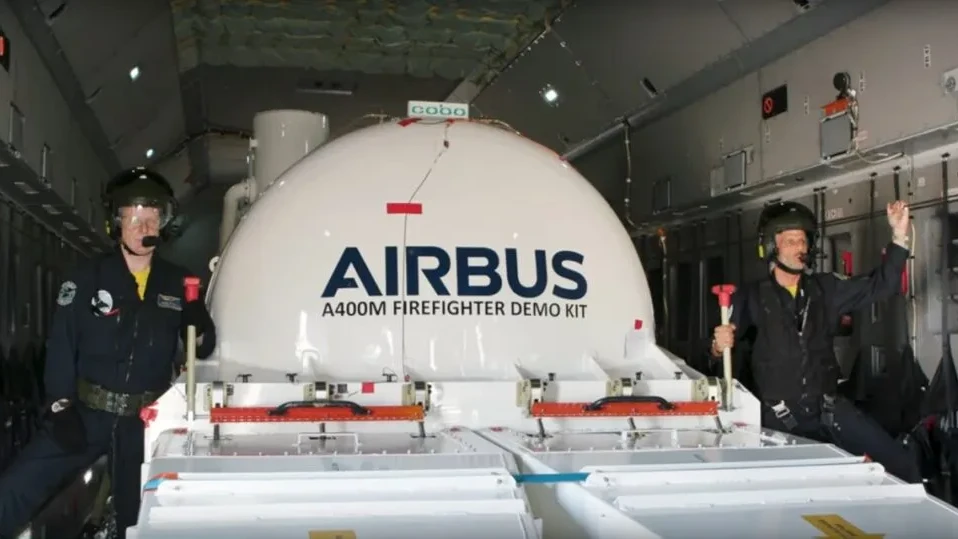
Spanish Prime Minister Pedro Sánchez recently announced that the Air Force would equip its Airbus A400M aircraft with firefighting kits for the current summer season. This initiative aims to bolster aerial resources for combating increasingly severe forest fires across Europe. However, reports indicate that the "firefighting kits" are not yet operational and exist only as two prototypes. One prototype will serve as the basis for future production, but the timeline for mass manufacturing and integration into the A400M fleet remains uncertain. Production will likely be limited, as not every A400M aircraft, either in Spain or other operating countries, will be equipped. Furthermore, training for flight crews and ground personnel is still required. The kit, developed by Cobo, is a simple container that fits into the cargo bay without requiring aircraft modifications. It can carry 20,000 liters of water with retardant, discharged by gravity. While the A400M can land on unpaved runways for rapid refilling, potentially reducing turnaround times compared to traditional water bombers, Cobo, a newcomer to aeronautical parts, must undergo Airbus supplier certification and design approval. The operational readiness of these kits, beyond potential public relations demonstrations, is therefore questionable for the immediate future. Separately, Spain's plan to acquire seven modern De Havilland DHC-515 (Canadair) aircraft is proceeding, though delivery dates are also unspecified.
The announcement regarding the A400M firefighting kits highlights a common challenge in defense procurement and rapid deployment: the gap between political statements and operational reality. While the concept of adapting existing military transport aircraft for firefighting is innovative and addresses a growing need, the reliance on prototypes and the extended certification processes suggest a potential misalignment between stated timelines and technical readiness. This situation underscores the importance of robust project management and realistic forecasting in government initiatives, particularly when public safety and critical infrastructure are involved. The long-term viability of such systems will depend on efficient scaling of production, comprehensive training protocols, and seamless integration into existing emergency response frameworks, while also considering the evolving landscape of climate change impacts and the necessity for adaptable aerial firefighting capabilities.
AI-generated to prompt reflection — not editorial opinion, not advice, not a statement of fact. How this works.