Spain's Football Evolution: From 'Red Fury' to Tactical Masters
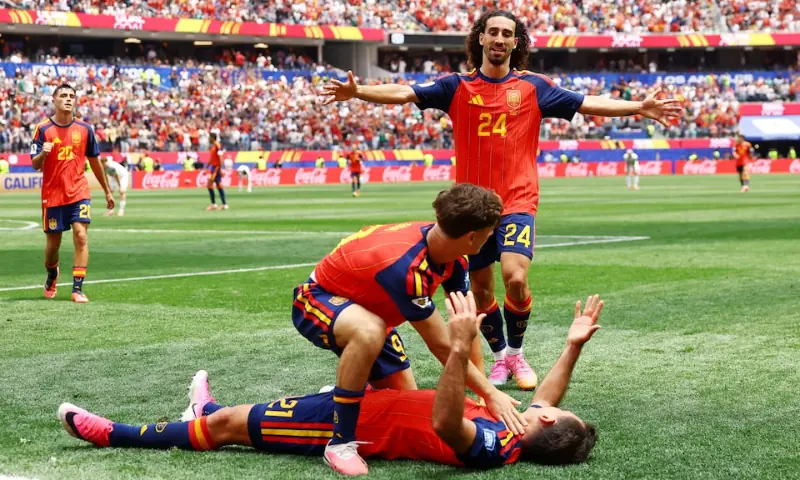
Spain's national football team has transformed from the aggressive 'La Furia Roja' to a tactically sophisticated and technically immaculate side, now perennial World Cup favorites. This evolution is not attributed to a single golden generation or manager, but to a decades-long, adaptive footballing system. Initially, Spain struggled to translate domestic strength into international success, with the 1964 European Championship being their sole major title for many years.
The shift began at Barcelona's La Masia academy under Johan Cruyff in 1988, emphasizing possession, intelligence, and spatial awareness within a 4-3-3 framework. This philosophy permeated the Spanish Football Federation's youth structures, creating a unified approach across clubs. The grassroots system prioritizes decision-making, technical skill, and football intelligence through structured age groups, competitive leagues, and reserve teams playing in professional systems, enabling young talents like Lamine Yamal to integrate seamlessly.
This structured development culminated in a golden era between 2008 and 2012, with victories in Euro 2008, the 2010 World Cup, and Euro 2012, characterized by the 'tiki-taka' style. However, by the mid-2010s, this predictable possession-based game became sterile, leading to early World Cup exits in 2014, 2018, and 2022. Under current coach Luis de la Fuente, Spain has modernized, retaining possession dominance but adding verticality, unpredictability, and direct attacking play through wingers like Yamal and Nico Williams. Their record fourth Euro 2024 title, won with a perfect record, demonstrated this new balance of control, speed, and directness, a momentum they carry into the World Cup final against Argentina.
Spain's footballing metamorphosis from a passion-driven 'Red Fury' to a control-oriented, tactically fluid powerhouse illustrates the critical interplay between long-term systemic development and adaptive strategy. The nation's success highlights how embedding a core philosophy, like Cruyff's principles, within a robust youth structure can yield sustained elite performance. However, the narrative also underscores a crucial lesson in organizational evolution: even successful systems must remain agile. Spain's mid-2010s stagnation demonstrates that adherence to a proven method can become a liability if it fails to account for evolving competitive landscapes and opponent adaptations. The current resurgence, marked by a blend of possession and directness, suggests a mature understanding that principles should guide, but not rigidly dictate, tactical execution. This approach offers a transferable model for any complex organization aiming for enduring relevance in dynamic environments, emphasizing the necessity of continuous self-assessment and strategic recalibration to avoid obsolescence.
AI-generated to prompt reflection — not editorial opinion, not advice, not a statement of fact. How this works.