Spain's PM Visits Ceuta After 57 Migrants Die Crossing from Morocco
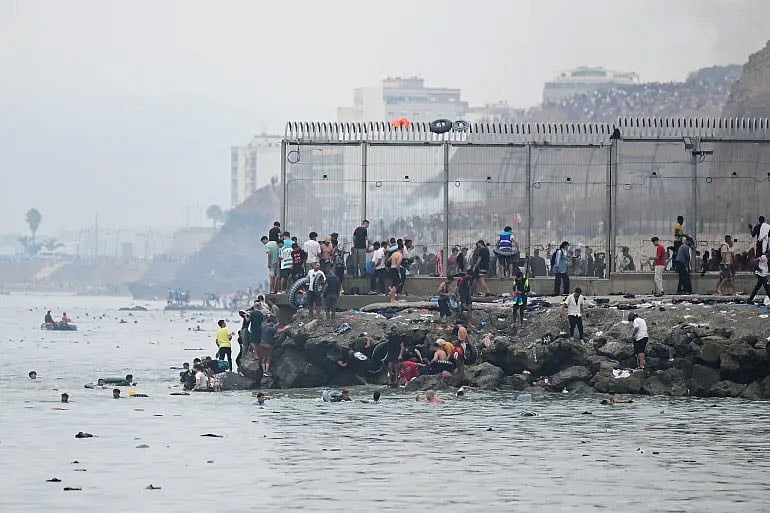
Thousands of people have entered Spain's enclave of Ceuta from Morocco in the past 24 hours, with at least 57 asylum seekers dying during the perilous border crossing. Spanish Prime Minister Pedro Sánchez visited Ceuta on Friday amid this escalating crisis. The regional president of Ceuta, Juan Jesús Vivas, confirmed the deaths of the 57 migrants to journalists but provided no details on the cause of their demise. Vivas stated that approximately 60,000 individuals used both land and sea routes to enter Ceuta from Morocco, with many swimming across the border fence in the sea.
Prime Minister Sánchez described the influx as a "violation" of Spain's territorial sovereignty and announced that authorities are expediting the return of migrants who arrived this week. The Spanish Interior Ministry reported that around 25,000 people had been sent back to Morocco by Friday. Local union leader Rachid Sabihi, representing Civil Guard officers in Ceuta, characterized the situation as a "terrible humanitarian crisis," noting that thousands of migrants, including unaccompanied children, are sleeping on sidewalks and wandering aimlessly. He indicated that many of the deceased drowned, while others were trampled to death at border checkpoints while attempting to scale the barrier near Tarajal beach.
Moroccan authorities deployed water cannons at the gates to push people back, leading to clashes and resulting in burned vehicles. Video footage showed large numbers, predominantly young men but also families with children, crossing the sea fence onto local streets. Ceuta and the nearby Spanish enclave of Melilla are the only land borders between the European Union and Africa, making them frequent entry points for those seeking to reach Europe. Migrants often swim approximately five kilometers from Fnideq, Morocco, to reach Ceuta, or attempt shorter routes from nearby Beliyunesh.
Ceuta authorities are linking the surge to a recent Spanish Supreme Court ruling that prevents immediate expulsion of migrants arriving by sea without due process, though this ruling does not apply to those entering via land or scaling fences. Sánchez suggested that human trafficking rings exploited this ruling, spreading misinformation among migrants. However, Moroccan rights activists doubt the ruling's influence, arguing most migrants were unaware of such legal decisions. European Commission President Ursula von der Leyen called the situation "unacceptable," emphasizing the need to stop dangerous crossings and dismantle trafficking networks while facilitating returns within legal frameworks. Germany and France have expressed solidarity with Spain, offering support and increasing border controls, respectively. Italy's Prime Minister Giorgia Meloni threatened to suspend the Schengen agreement over the crisis. Ceuta's regional government requested an emergency declaration and military deployment, but the Spanish Interior Ministry rejected the call for a national emergency, deeming it outside the scope of such a declaration, while pledging additional support.
The significant influx of migrants into Ceuta, resulting in tragic loss of life, highlights the complex interplay of geopolitical factors, legal interpretations, and humanitarian challenges at the EU's external borders. The event underscores the persistent pressure of migration from North Africa into Europe, driven by economic disparities and instability. Spain's response, balancing territorial integrity with humanitarian concerns, reflects the broader EU struggle to manage migration flows effectively. The differing interpretations of legal rulings by Spanish authorities and migrant rights groups reveal systemic ambiguities in asylum and border policies. This situation may intensify debates around border security, the role of international cooperation with transit countries like Morocco, and the ethical implications of restrictive immigration policies. The long-term implications could involve increased securitization of borders, potential shifts in EU migration policy frameworks, and ongoing humanitarian crises if root causes of migration are not addressed.
AI-generated to prompt reflection — not editorial opinion, not advice, not a statement of fact. How this works.