Speed and incline: how a toll booth barrier became a ramp, launching a car into the roof in Brazil
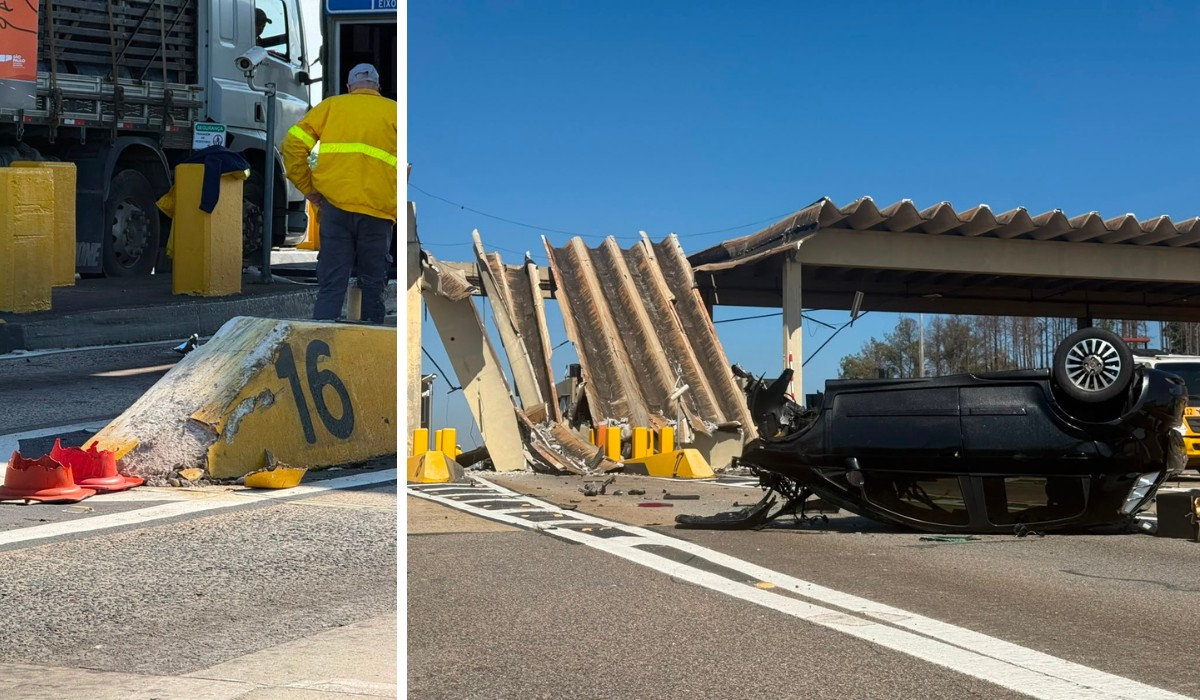
A fatal accident occurred on Sunday, the 26th, in Campinas, São Paulo, Brazil, when a 24-year-old driver died after his car struck a toll plaza. Security camera footage captured the moment the vehicle, traveling at high speed, hit a concrete barrier that acted as a ramp, launching the car upwards into the overhead structure and causing a section of the roof to collapse. Experts from the State University of Campinas (Unicamp) explained that the unusual trajectory was due to the combination of the car's excessive speed and the wedge-shaped, inclined design of the barrier. This specific geometry, according to physics professor Leandro Tessler, caused the vehicle to 'take off' rather than simply collide with the barrier. Another Unicamp professor, Creso de Franco Peixoto, noted that the significant damage to the car and the toll plaza roof indicated a very high velocity. The concessionaire managing the road, Renovias, stated that its engineering department is assessing the structural integrity and planning reconstruction. They also worked to reactivate affected toll lanes on Monday, the 27th. While the barrier's design was a critical factor, experts emphasized that the driver's extreme speed was a primary cause. They suggested that alternative barrier designs might have resulted in different, potentially more severe, direct impacts. The incident has prompted discussions about enhancing safety measures at toll plazas, potentially including energy-absorbing terminals, which are used on other highways to mitigate impact forces. However, the speed involved in this accident was significantly beyond normal expectations for approaching a toll booth, suggesting that even advanced safety devices might not fully prevent severe outcomes.
This incident highlights a critical intersection of engineering design, human behavior, and traffic safety at toll plazas. The specific geometry of the concrete barrier, combined with excessive vehicle speed, created an unintended ramp effect, leading to a catastrophic outcome. While the barrier's design played a role, the analysis points to the driver's speed as a significant contributing factor, suggesting that even robust safety features may be overwhelmed by extreme velocity. This event underscores the need for a systemic approach to toll plaza safety, potentially involving a review of barrier designs, speed enforcement strategies, and the implementation of advanced impact-mitigation technologies. Future considerations might include dynamic speed management systems and barriers designed to absorb or redirect energy more effectively across a range of impact speeds, acknowledging that current designs are often optimized for standard collision scenarios rather than extreme events.
AI-generated to prompt reflection — not editorial opinion, not advice, not a statement of fact. How this works.