Startup Bioprints Kidney and Liver Tissue in Space for the First Time
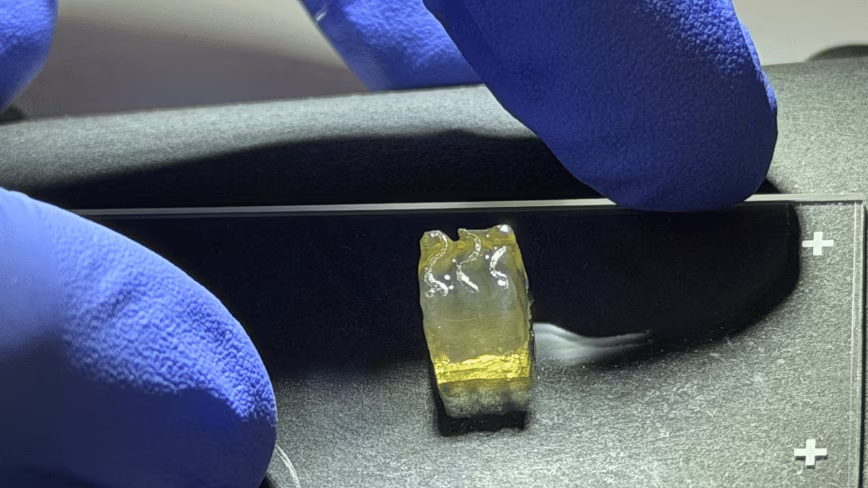
Auxilium Biotechnologies has successfully bioprinted kidney and liver tissue in space, marking a significant first for the company and for bioprinting technology. The groundbreaking achievement took place aboard the International Space Station (ISS). The printed tissue samples were returned to Earth last month via a SpaceX cargo capsule. Auxilium Biotechnologies announced these results on Thursday, confirming the success of their mission. This endeavor was not an isolated event, as the company also conducted other experiments during the same mission. The ability to bioprint complex tissues in microgravity opens up new avenues for medical research and therapeutic development. Future applications could include creating more accurate disease models for drug testing and potentially developing tissues for transplantation. This advancement represents a crucial step towards regenerative medicine and understanding cellular behavior in extraterrestrial environments.
The successful bioprinting of kidney and liver tissue in space by Auxilium Biotechnologies demonstrates a novel application of 3D printing technology in microgravity. This capability could accelerate research into organoid development and disease modeling, potentially offering more accurate preclinical testing platforms. The long-term implications for regenerative medicine and pharmaceutical development warrant close observation as the technology matures. Future challenges will likely involve scaling production, ensuring long-term tissue viability, and navigating the complex regulatory pathways for space-based biomedical innovations. This achievement highlights the growing synergy between space exploration and advanced biotechnologies, promising new insights into biological processes under extreme conditions.
AI-generated to prompt reflection — not editorial opinion, not advice, not a statement of fact. How this works.