Startup Claims Memory, Not Compute, is AI's Bottleneck, Develops GPU-Alternative Server
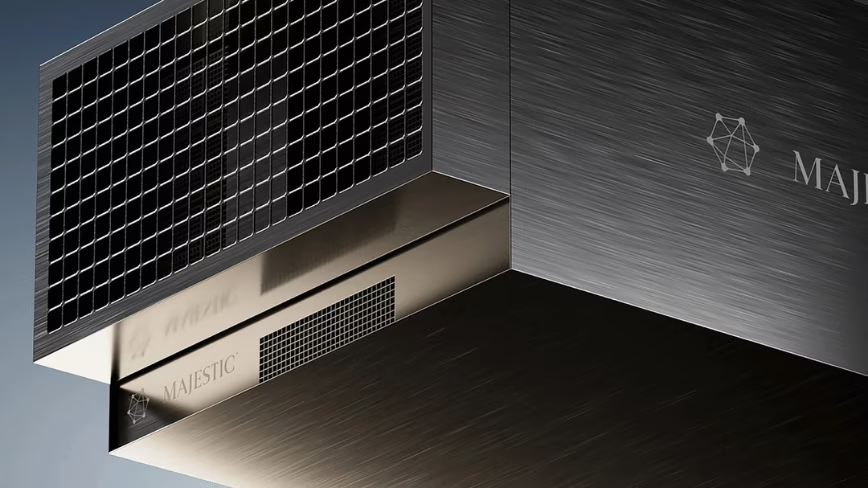
Majestic Labs, a Tel Aviv-based startup founded in 2023 by former Google and Meta engineers, is challenging the prevailing focus on computational power in AI hardware development. The company argues that memory, rather than compute, represents the true bottleneck for artificial intelligence. To demonstrate its thesis, Majestic Labs has unveiled a new server designed to perform the work typically requiring a full rack of Nvidia GPUs. This innovative approach aims to shift the industry's attention from solely optimizing processing power to addressing memory limitations. The startup's solution suggests a potential paradigm shift in how AI infrastructure is designed and implemented. By prioritizing memory efficiency, Majestic Labs seeks to offer a more scalable and potentially cost-effective alternative to current GPU-centric solutions. Their development could influence future trends in AI hardware, encouraging a broader exploration of memory-centric architectures.
AI development has largely centered on enhancing computational throughput, often through advancements in GPU technology. However, Majestic Labs' assertion that memory capacity and speed are the primary constraints introduces a critical counterpoint. This perspective suggests that future AI performance gains may be more significantly influenced by innovations in memory architecture and management, rather than solely by increasing raw processing power. The company's development of a GPU-alternative server highlights a potential strategic pivot for the industry, moving towards more memory-centric designs. This could lead to more energy-efficient and cost-effective AI infrastructure, especially as models continue to grow in size and complexity. Evaluating this approach requires considering the long-term implications for hardware design, software optimization, and the overall scalability of AI deployment in the coming decade.
AI-generated to prompt reflection — not editorial opinion, not advice, not a statement of fact. How this works.
