Strait of Hormuz control is Iran's 'nuclear weapon,' says Medvedev
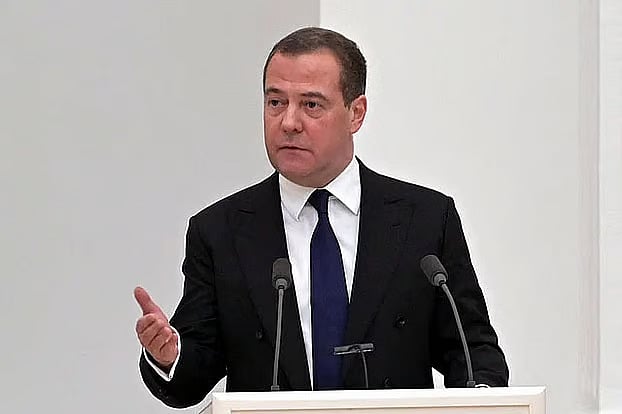
Dmitry Medvedev, Deputy Chairman of Russia's Security Council, stated that Iran's control over the Strait of Hormuz is a powerful strategic asset, comparable to a nuclear weapon. Speaking to journalists after a visit to Iran, Medvedev highlighted that the ability to regulate shipping through this vital waterway demonstrates Tehran's significant strategic capabilities. He warned that if a wider conflict erupts in the Middle East, Iran could potentially block passage through the Bab-el-Mandeb strait, which would severely disrupt global oil and commercial goods transportation. Medvedev expressed hope that such a scenario would not materialize but urged those inciting conflict in the region to consider this possibility. He also criticized the recent US attack on Iran, deeming it unprovoked and a violation of international law, especially as discussions were ongoing and Iran posed no threat. Russia had previously proposed peaceful solutions to concerns regarding Iran's nuclear program. Medvedev acknowledged that while any dialogue or agreement is preferable to conflict, reaching a final deal between the US and Iran will be challenging, particularly regarding the lifting of sanctions and funding for Iran's reconstruction. During his visit, Medvedev also discussed with Iranian President Masoud Pezeshkian the creation of a joint platform for sanction-affected countries to collaborate against imposed restrictions, a concept first proposed by Tehran years ago. Medvedev met Pezeshkian in Tehran last Friday during the funeral ceremonies for Iran's Supreme Leader Ayatollah Ali Khamenei, attending as a special envoy from Moscow to offer condolences.
Dmitry Medvedev's assertion frames Iran's control over the Strait of Hormuz as a potent strategic leverage, drawing a parallel to nuclear deterrence. This perspective underscores the critical role of chokepoints in international trade and security, highlighting how geographic control can translate into significant geopolitical influence. The analysis suggests that any escalation in the Middle East could have cascading global economic consequences, impacting energy markets and supply chains. Medvedev's commentary also implicitly critiques Western foreign policy actions, positioning Russia as a proponent of diplomatic solutions and highlighting the potential for international coalitions to counter unilateral sanctions. The discussion on a joint platform for sanction-affected nations points to evolving geopolitical alignments and a potential challenge to existing global economic governance structures in the coming decade.
AI-generated to prompt reflection — not editorial opinion, not advice, not a statement of fact. How this works.