Student leader's party ends protest after Education Minister's resignation
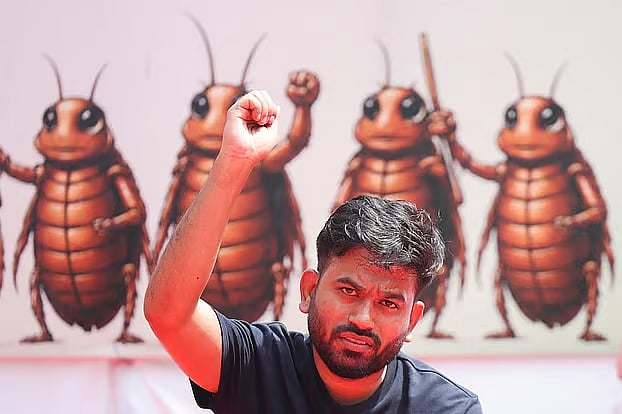
Abhijit Dipke, founder of the online group 'Cockroach Janatha Party' (CJP), announced the end of their protest movement on Saturday, July 25, 2026. This decision followed the resignation of Dharmendra Pradhan as India's Union Education Minister. Dipke, who was studying in the US at Boston University when he formed the CJP on May 16, returned to India on June 6 to join student protests. The CJP gained significant online attention, particularly on Instagram, within a week of its formation. The movement was sparked by a comment from India's Chief Justice Surya Kant, which many interpreted as comparing unemployed youth to cockroaches. Dipke's initial post on X questioned, "What happens if all cockroaches come together?" The CJP's protests, amplified through social media, demanded Pradhan's resignation following allegations of leaked medical entrance exam papers and subsequent cancellation. Dipke's parents, Bhagwan Shankar and Anita, expressed pride in their son's achievements. His father, a retired civil engineer, stated he never imagined his son would become so prominent, while his mother noted Dipke faced adversity but fought patiently. The family resides in Chhatrapati Sambhajinagar (formerly Aurangabad), Maharashtra. Dipke's father hopes his son will join the civil services, a path he believes offers a stable career, though Dipke himself initially aspired to be a journalist and had a passion for cricket. He holds a journalism degree from Tilak Maharashtra Vidyapeeth and was pursuing a higher degree in public relations at Boston University, funded by an education loan his father is still repaying.
The emergence of Abhijit Dipke and the Cockroach Janatha Party highlights the growing influence of digitally-native social movements in India. The swift mobilization around issues of educational integrity, amplified by social media, demonstrates a powerful new form of civic engagement. While the immediate objective of securing the Education Minister's resignation was achieved, the long-term implications for political participation and governance are significant. The narrative framing, using 'cockroaches' as a symbol, while effective for viral appeal, raises questions about the sustainability and constructive potential of such provocative rhetoric in political discourse. Future challenges will involve translating online momentum into sustained policy influence and navigating the complex landscape of Indian politics beyond single-issue campaigns. The involvement of students and the focus on educational reform suggest a generation seeking greater accountability from public institutions.
AI-generated to prompt reflection — not editorial opinion, not advice, not a statement of fact. How this works.