Student Wings Clash at Three Dhaka Educational Institutions
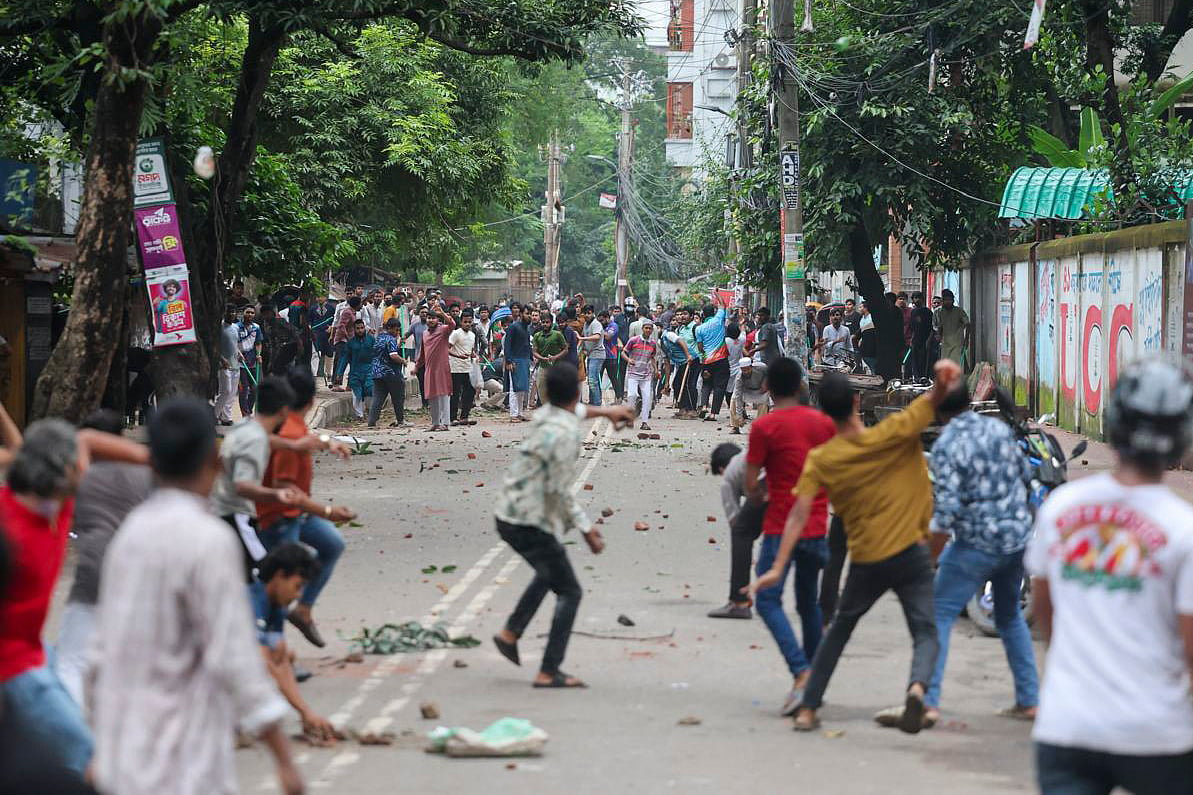
Student organizations JCD (Chatra Dal) and Islami Chhatra Shibir clashed at three educational institutions in Dhaka on Tuesday, marking the largest confrontation between the two groups since the July mass uprising. The clashes began at Jagannath University around noon and spread to Dhaka College and Government Madrasah-e-Alia, resulting in over fifty injuries. Tensions persisted until the evening. This follows a similar clash between JCD and Shibir at Begum Rokeya University in Rangpur on Monday, bringing the total to four educational institutions experiencing conflict in two consecutive days.
Prior to the August 5, 2024, uprising that led to the fall of the Awami League government, university campuses were dominated by the student wing of the ruling party, which allegedly attacked JCD and Shibir members. With the ruling party's student wing now banned, Shibir-backed panels have won most student union elections at five major universities, while JCD has performed poorly. JCD claims Shibir consolidated its power discreetly during the Awami League era while JCD was forced to operate off-campus. Recently, JCD has attempted to corner Shibir, including an incident at Dhaka University on August 2 concerning alleged homosexual activity, which also led to clashes.
At Jagannath University, the conflict escalated when JCD members and proctorial staff blocked representatives from the Jagannath University Central Student Parliament (JAKSU), National Student Power, and Inqilab Manch from entering a documentary screening. JCD alleged that Shibir and its affiliates planned to insult the chief guest, UGC Chairman Professor Mamun Ahmed. After the seminar, a physical altercation occurred near the Shahid Minar, involving JCD leaders and Shibir members, including the JAKSU Social Service Secretary and Shibir's Publicity Secretary. The violence extended to the university's medical center and involved attacks on students from other groups, with over 50 individuals receiving treatment at Dhaka National Medical College Hospital, many with head injuries. The university has formed a four-member investigation committee and increased security.
At Dhaka College, tensions flared between JCD and Shibir, leading to a physical confrontation and JCD members positioning themselves outside the campus. At Government Madrasah-e-Alia, clashes also occurred, with accusations of JCD members occupying and damaging Shibir-controlled rooms. The involvement of local JCD, Jubo Dal, and BNP leaders was reported, and the principal of the Madrasah is alleged to have been assaulted by Jubo Dal members.
The recent widespread clashes between JCD and Islami Chhatra Shibir at educational institutions highlight the volatile power dynamics in Bangladesh's higher education sector following the July mass uprising. The competition for influence and control over campus spaces, exacerbated by the absence of previously dominant student groups, appears to be a primary driver of these conflicts. The alleged attempts to provoke or insult key figures, alongside disputes over room occupations and construction tenders, suggest a complex interplay of political maneuvering, resource competition, and ideological friction. Moving forward, addressing the systemic issues that fuel such inter-group violence, such as ensuring equitable access to resources, promoting inclusive governance structures within student bodies, and establishing robust mechanisms for conflict resolution, will be crucial for restoring stability and fostering a conducive learning environment. The long-term implications for student activism and institutional governance in the post-uprising era remain a critical area to monitor.
AI-generated to prompt reflection — not editorial opinion, not advice, not a statement of fact. How this works.
