Stunning Astronomy Photos from the 2026 Royal Museums Greenwich Competition
The Royal Museums Greenwich has released a selection of remarkable images shortlisted for the 2026 Astronomy Photographer of the Year competition. This prestigious annual event showcases the extraordinary skills and creativity of astronomers and photographers worldwide. This year, approximately 4,000 submissions from professional and amateur photographers across 66 countries were received. The winners for 2026 will be announced on September 17th, with the winning and selected photographs going on display at the National Maritime Museum in London starting September 18th.
Among the highlighted images is "Golden Sunrise Over Seattle," capturing the city bathed in golden light as a large orange moon rises behind its skyscrapers, a blend of human architecture and natural beauty. Another striking entry, "Andromeda's Crimson Swirl," by Chinese photographers, depicts red gas and dust spiraling towards the black hole at the center of the Andromeda galaxy, alongside newly formed bright blue stars. "Eiffel Tower and Supermoon" by a French photographer presents a meticulously planned shot where the moon appears unusually large behind the iconic tower due to a significant distance.
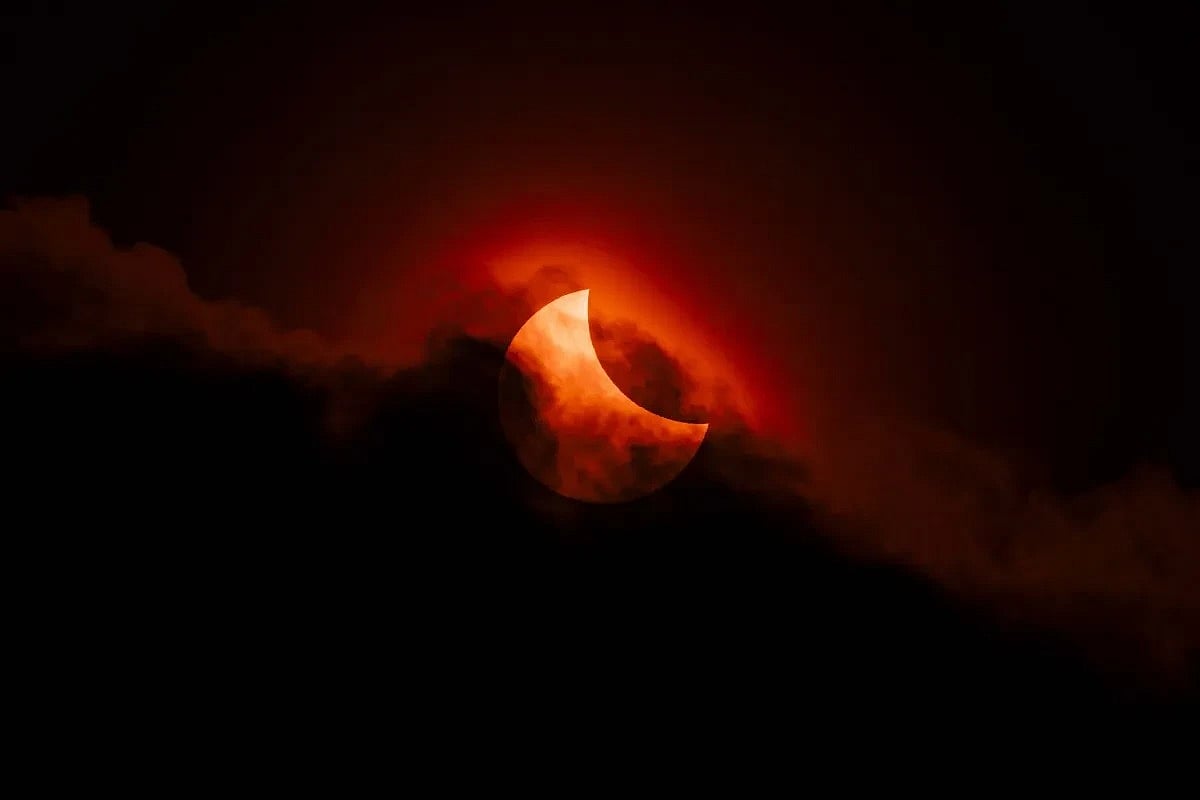
Further captivating images include "Comet C/2025 A6 (Lemon) Over the Alps," taken by Jacob Sahners after a challenging hike in the Swiss Alps, and "Shadow Moon," a composite image by Richard Addiscott that meticulously documents the moon's surface changes over two weeks during its waning phase. A solar flare is vividly captured in "Solar Flare" by 14-year-old O Chen Lin from China, which earned a spot in the junior category. "Partial Solar Eclipse Behind Clouds" by James McBeath offers a unique perspective on the eclipse through drifting clouds. "Aurora Over the Mountains" by Julien Cadena showcases the aurora borealis near Norway's 'Devil's Tooth' peak. "Helix Nebula," a remnant of a dead star, is presented by Humberto Cedric from Chile. Finally, "Cosmic Neighbors" by Yijing Zhu and Xinghan Yang features the Bode's Galaxy and the starburst-ridden Cigar Galaxy in close proximity.
This competition highlights the increasing accessibility of advanced astronomical observation and photography, even for amateurs. The diverse range of images, from planetary phenomena to deep-space objects and terrestrial landscapes illuminated by celestial events, reflects both technological advancements and a growing public fascination with the cosmos. The inclusion of a junior category winner underscores the importance of early engagement in STEM fields. Future trends may see greater integration of AI in image processing and potentially in guiding observational setups, further democratizing the capture of stunning astronomical visuals and pushing the boundaries of what can be observed and shared.
AI-generated to prompt reflection — not editorial opinion, not advice, not a statement of fact. How this works.