Submillimeter Array Rapidly Detects Gamma-Ray Burst Using New Automated Alert System
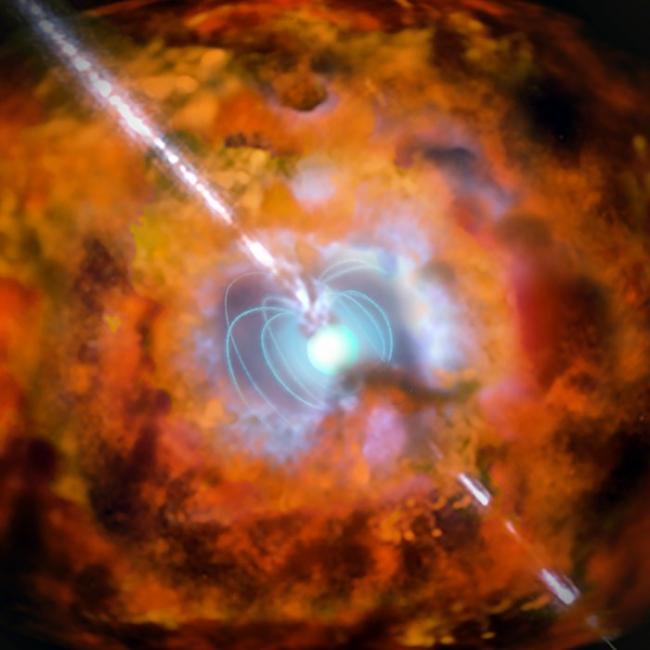
The Submillimeter Array (SMA), a radio interferometer, has successfully detected a gamma-ray burst (GRB) thanks to its newly implemented semi-automated alert system. This event highlights the system's capability to respond swiftly to transient astronomical phenomena discovered by space-based observatories. The SMA's ability to quickly pivot its observational resources allows astronomers to study these high-energy events in unprecedented detail. Gamma-ray bursts are the most luminous electromagnetic events known in the universe, and their rapid detection is crucial for understanding their origins and the extreme physics involved. This new system represents a significant advancement in the SMA's observational flexibility and its contribution to multi-messenger astronomy. The successful detection underscores the importance of rapid response capabilities in modern astronomical research, enabling scientists to capture fleeting cosmic events.
The successful rapid detection of a gamma-ray burst by the Submillimeter Array, facilitated by its new automated alert system, showcases the evolving synergy between space-based and ground-based observatories. This technological advancement allows for more agile scientific investigation, enabling the capture of transient cosmic events that were previously difficult to observe in detail. The development reflects a broader trend in scientific instrumentation towards increased automation and faster data processing, crucial for maximizing the scientific return from increasingly complex and expensive observational facilities. Such systems are vital for advancing our understanding of extreme astrophysical phenomena and could pave the way for more integrated multi-messenger astronomy initiatives in the coming decade.
AI-generated to prompt reflection — not editorial opinion, not advice, not a statement of fact. How this works.