Suxian Micro Unveils Domestic GPGPU for Embodied AI in Tianjin
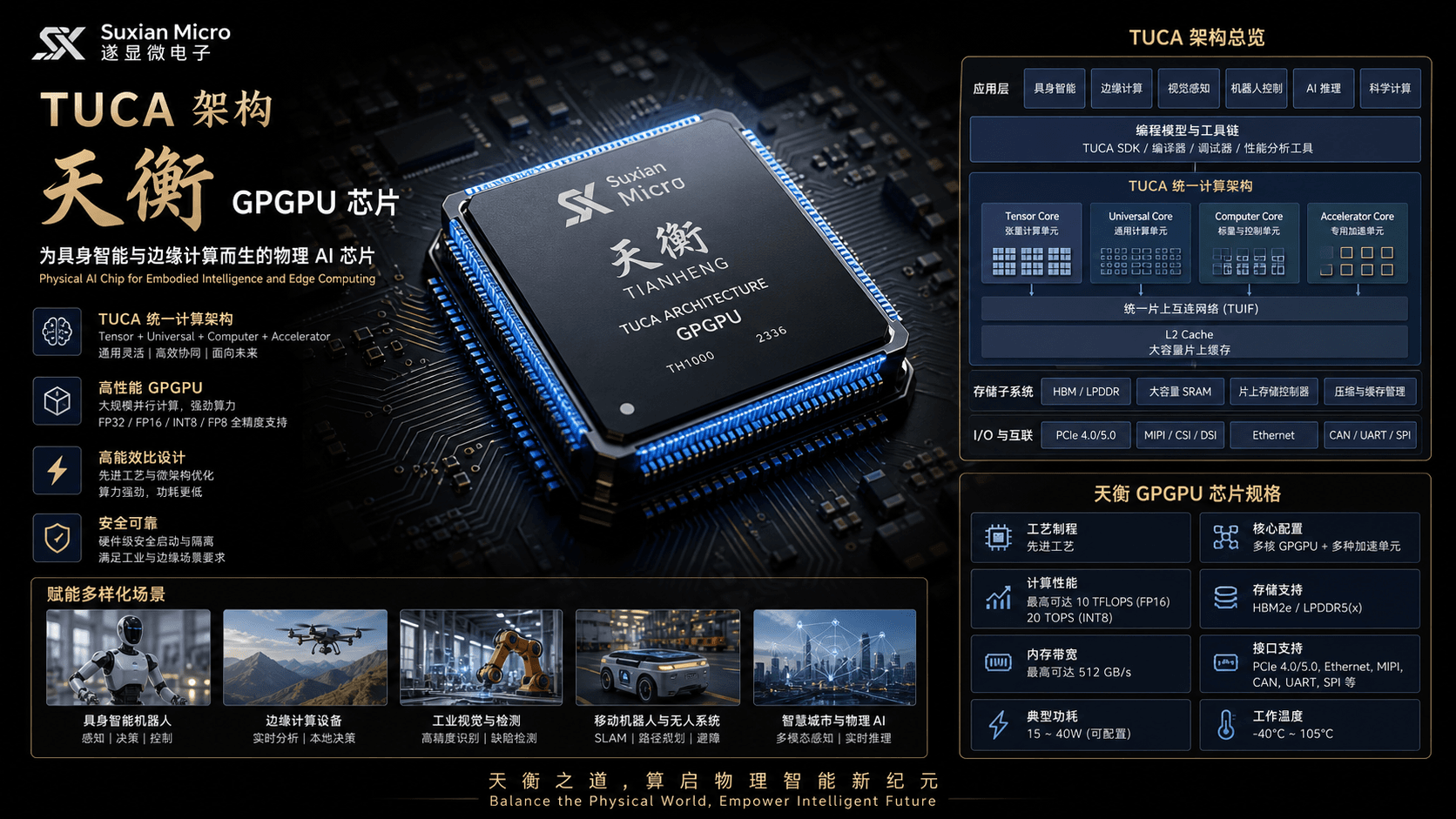
Tianjin-based Suxian Micro has released its TUCA Unified Computing Architecture, highlighted by the Tianheng GPGPU (TH1100). This new GPGPU is designed to power embodied artificial intelligence applications and boasts a significant computing power of 100 teraflops. A key innovation is its in-chip compute-storage fusion technology, which aims to enhance processing efficiency by integrating data storage directly within the processing unit. Additionally, the TH1100 incorporates AI ROM technology, suggesting specialized hardware acceleration for artificial intelligence tasks. The development logic follows a 'render-first-then-AI' approach, indicating a focus on visual processing capabilities as a foundation for AI operations. This release marks a significant step in domestic GPU development within China, particularly for the burgeoning field of embodied intelligence.
The introduction of the TH1100 GPGPU by Suxian Micro signifies a push towards domestic capabilities in specialized AI hardware, particularly for embodied intelligence applications. The integration of compute-storage fusion and AI ROM technology addresses critical bottlenecks in current AI processing, potentially offering performance advantages. This development aligns with global trends in AI hardware innovation, where specialized architectures are increasingly crucial for handling complex tasks. The 'render-first-then-AI' paradigm suggests a strategic focus on visually-driven AI, which is central to robotics and autonomous systems. As the AI era matures, such specialized hardware will be vital for enabling more sophisticated and efficient AI deployments across various sectors.
AI-generated to prompt reflection — not editorial opinion, not advice, not a statement of fact. How this works.