Swedish Scientists' Quest for Element 102: The Nobelium Story
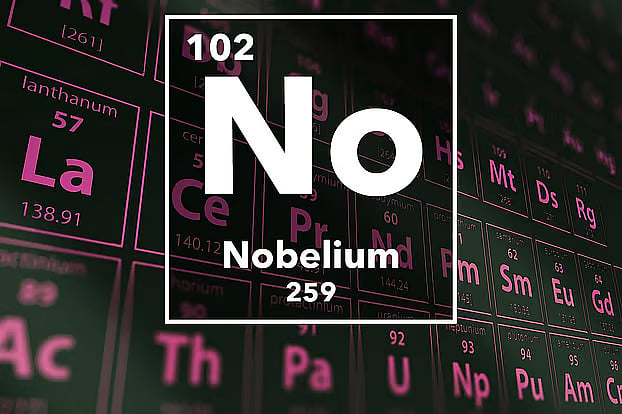
In 1957, a small team of Swedish scientists at Stockholm University's Nobel Institute for Physics announced the discovery of element 102. Working with limited financial resources and basic equipment, they challenged larger, better-funded laboratories worldwide. Their research involved bombarding targets with particle accelerators, a technique that had evolved from neutron capture to fusion. Fusion aims to combine lighter nuclei into heavier ones, but often results in immediate fission of the compound nucleus. The process requires overcoming the Coulomb barrier, the repulsive force between positively charged protons. Scientists accelerate light nuclei and shoot them at heavy nuclei targets. However, the resulting compound nucleus typically breaks apart into two lighter nuclei, a process called fission, due to high energy. Nature offers a way out: when a nucleus is in an excited state, it tries to stabilize by releasing energy, a process called evaporation. This can involve emitting neutrons and photons. Rarely, this evaporation leads to a stable new nucleus, marking the discovery of a new element. In 1954, the same Swedish team attempted to discover element 100 using uranium targets and oxygen ions, unaware that American scientists had already confirmed element 100, Fermium, derived from nuclear bomb samples. Despite this setback, the Swedish team persevered, aiming for element 102. They used plutonium targets from England and a neon-22 isotope beam from Switzerland, but low cross-sections prevented sufficient sample production for their homemade equipment to detect the new element. Undeterred, they collaborated with England's Atomic Energy Research Establishment and the U.S. Argonne National Laboratory. Argonne sent curium-244 isotopes to England, where they were attached to aluminum plates and sent to Stockholm. Swedish cyclotrons then bombarded these plates with carbon-13 isotopes. After bombarding targets for about thirty minutes in 1957, the team detected alpha decay in three targets, suggesting the presence of element 102. However, subsequent chemical tests were negative, leaving the scientists uncertain. Their results were not definitive due to the low sensitivity of their inexpensive detectors, a limitation imposed by their modest budget and the scarcity of high-quality research equipment in early nuclear physics. Despite these limitations, the Swedish scientists, in collaboration with Argonne and the UK's establishment, decided to publish their findings and named the newly discovered element Nobelium.
This account details the challenges and triumphs of early nuclear physics research, specifically the discovery of element 102, Nobelium. It highlights how scientific progress can occur even with limited resources, driven by ingenuity and collaboration. The narrative also implicitly touches upon the competitive nature of scientific discovery, particularly in the mid-20th century, where national interests and secrecy, as seen with the discovery of Fermium, could influence the pace and announcement of findings. The story underscores the importance of perseverance and the iterative process of scientific inquiry, where initial ambiguous results can lead to further investigation and eventual confirmation, often through international cooperation. Future research in this domain will likely continue to benefit from advanced computational modeling and more sensitive detection technologies, further accelerating the exploration of the periodic table.
AI-generated to prompt reflection — not editorial opinion, not advice, not a statement of fact. How this works.