Tajuddin Ahmad's Crucial Role in Bangladesh's Founding and Post-War Struggles
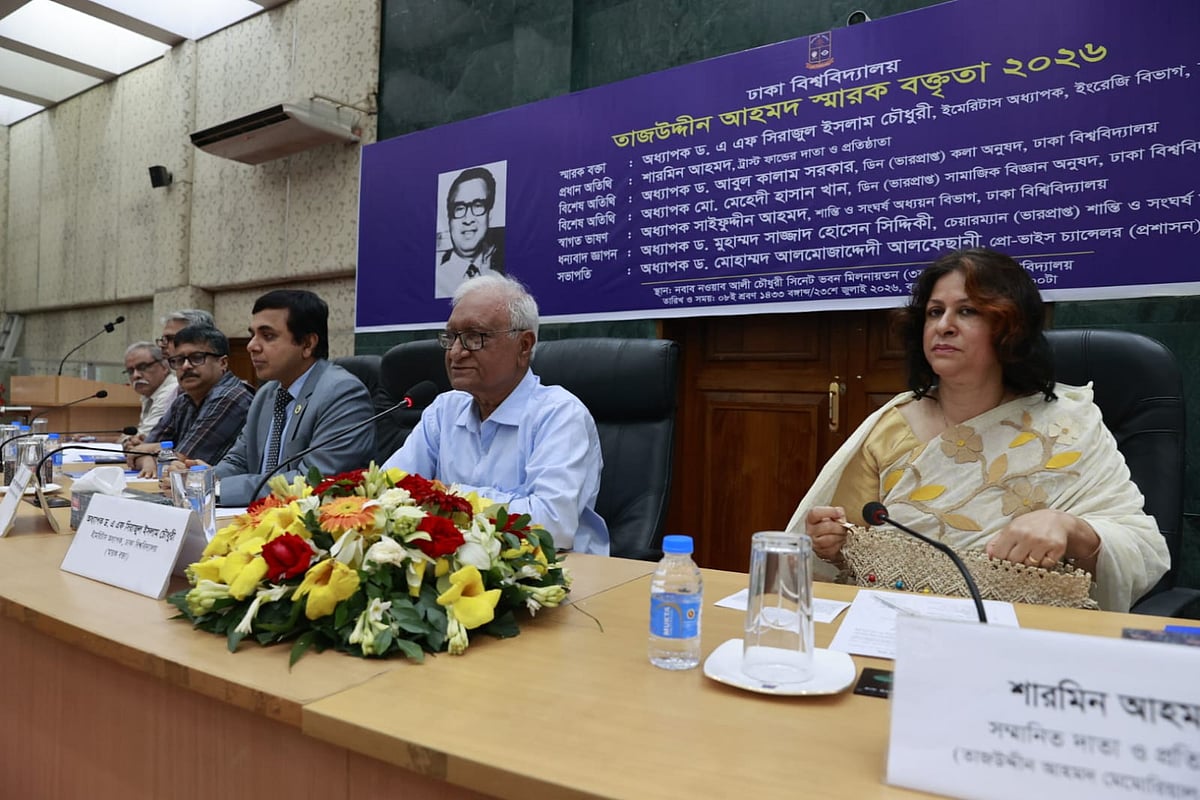
Professor Sirajul Islam Chowdhury of Dhaka University highlighted Tajuddin Ahmad's pivotal role during Bangladesh's founding crisis at the Tajuddin Ahmad Memorial Lecture held at the university's Nawab Nawab Ali Chowdhury Senate Building. Chowdhury noted that history often finds the right person for critical moments, and Ahmad admirably fulfilled a historic responsibility during Bangladesh's establishment. He also suggested that the reasons for Ahmad's later marginalization and death were rooted in historical circumstances, predicting Ahmad's enduring legacy and contribution to progress. The lecture, titled 'Tajuddin Ahmad's Political Life,' was attended by Ahmad's daughter, Sharmin Ahmad, as the chief guest. Professor Chowdhury detailed the disconnect between Sheikh Mujib and Tajuddin Ahmad after March 25, 1971, explaining that efforts were made from multiple sides to prevent unity between the absent Mujib and the struggling Ahmad. These efforts included Khondakar Mostaq Ahmad, who contacted Americans due to his anger over Ahmad's appointment as Prime Minister, and the Mujib Bahini, formed to prevent leftist leadership. Chowdhury argued that the Mujib Bahini was created not for conducting the liberation war but to counter leftist influence, particularly if Sheikh Mujib could not return to Bangladesh post-independence. He outlined four key post-independence disagreements between Tajuddin Ahmad and Sheikh Mujib: Ahmad's call for trials of war criminals versus Mujib's general amnesty after the Dalal Ain (Anti-Collaborator Act) in 1972; differing views on accepting aid from the World Bank and the United States; Ahmad's dissatisfaction with the formation of the Rakhi Bahini instead of his planned militia force for freedom fighters; and Ahmad's opposition to the formation of the one-party system, Bakshal. The lecture also touched upon Ahmad's early political life, including his role in the Language Movement, emphasizing his dedication to politics as a full-time pursuit driven by deep sensitivity and a sense of duty. Professor Chowdhury posited that Ahmad's inability to find sufficient organizational strength or suitable leadership to realize his revolutionary vision contributed to his isolation later in his political career. Sharmin Ahmad emphasized her father's immense contribution to the liberation war, calling it the 'mother' of Bangladesh, and expressed hope that Bangladesh would eventually recognize Ahmad's significance. The event also included the awarding of a peace gold medal and scholarships to students, as well as prizes for an essay competition on Tajuddin Ahmad.
This analysis examines the historical narrative surrounding Tajuddin Ahmad's contributions and subsequent political standing in Bangladesh. The lecture presents a perspective that frames Ahmad as a pivotal, yet ultimately marginalized, figure whose vision clashed with prevailing political currents and leadership decisions. The discussion points to internal political dynamics and external influences, such as potential American engagement and the formation of specific paramilitary groups like the Mujib Bahini and Rakhi Bahini, as factors shaping post-independence political alignments and conflicts. Analyzing these events through the lens of governance and institutional development, it appears that differing approaches to national reconciliation, economic policy (aid dependency), and security structures (militia vs. Rakhi Bahini) created significant friction. The narrative suggests a tension between revolutionary ideals and pragmatic state-building, highlighting the challenges faced by leaders who advocate for specific ideological or justice-oriented policies within a complex political landscape. Future analysis could explore the long-term implications of these policy divergences on Bangladesh's institutional trajectory and national identity.
AI-generated to prompt reflection — not editorial opinion, not advice, not a statement of fact. How this works.