Tencent Robotics Unveils Three Open-Source Embodied AI Models at WAIC 2026
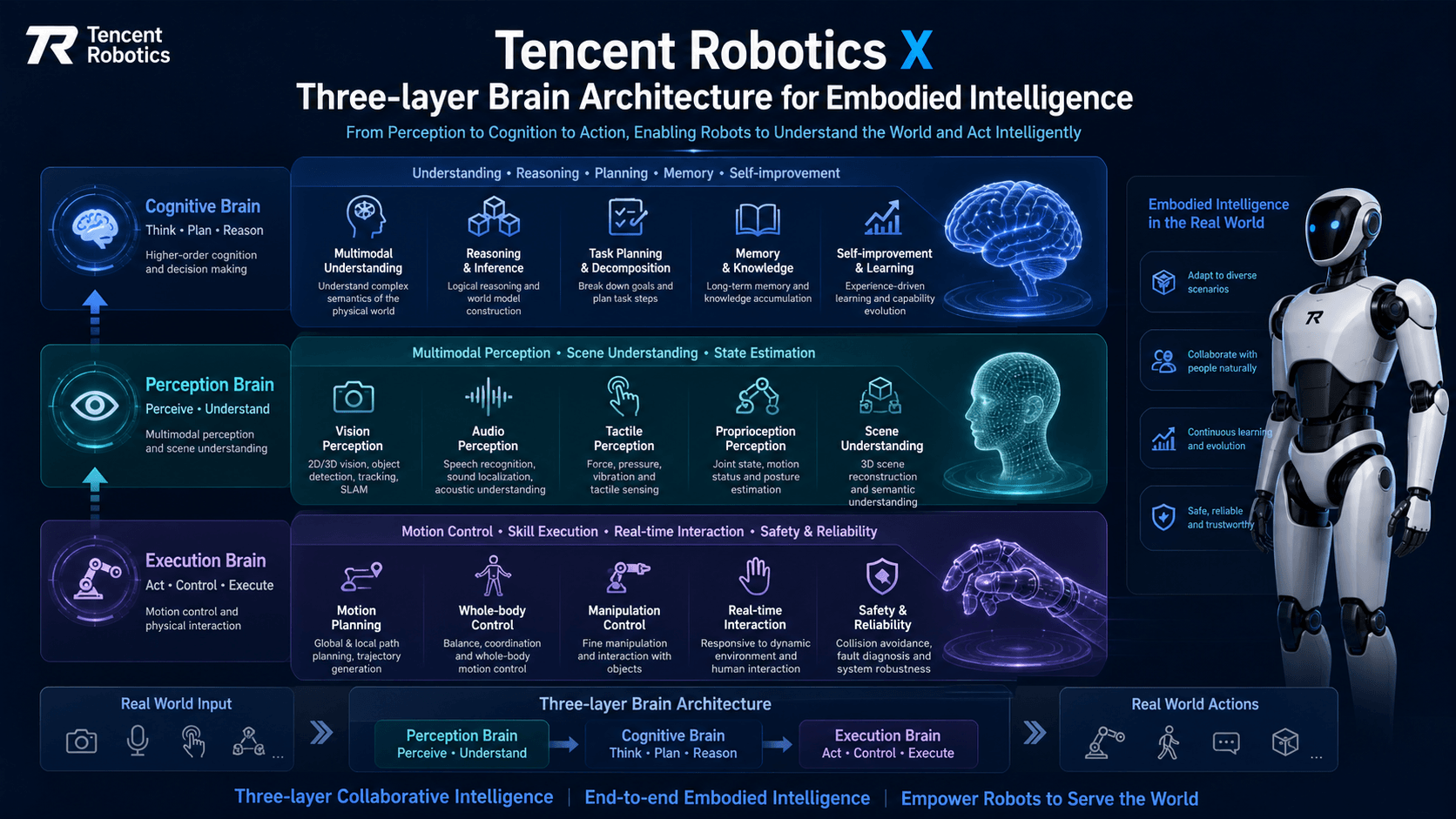
Tencent Robotics has announced the open-sourcing of three advanced embodied foundation models at the World Artificial Intelligence Conference (WAIC) 2026. These models are designed to significantly enhance robot capabilities in understanding their environment and executing actions with greater speed and precision. The first model, VLM, focuses on scene understanding, enabling robots to interpret complex visual information within their surroundings. Complementing this is RxBrain, a cognitive model that handles planning processes by integrating visual states, allowing robots to make more informed decisions. The third model, VLA, is engineered for continuous action execution, capable of operating at impressive frequencies of 500 to 1000 Hertz. Chief Scientist Zhang Zhengyou elaborated on the underlying technology, highlighting a novel 3-layer brain architecture that is crucial for achieving the rapid reaction speeds demonstrated by these new models. This initiative aims to foster broader innovation in the field of robotics by providing researchers and developers with powerful, foundational AI tools.
Tencent's release of three open-source embodied foundation models at WAIC 2026, featuring a novel 3-layer brain architecture for enhanced reaction speed, represents a significant contribution to the AI research community. By open-sourcing these tools, Tencent aims to accelerate progress in robotics, potentially democratizing access to advanced AI capabilities. This move could foster a more collaborative ecosystem, driving rapid iteration and innovation across the industry. The focus on embodied AI, particularly the ability to process visual information and execute continuous actions at high frequencies, aligns with the trajectory toward more physically capable and interactive AI systems. Examining the incentive structures behind such open-sourcing initiatives reveals a dual benefit: advancing the field while potentially establishing de facto standards and fostering developer loyalty around Tencent's ecosystem. The long-term impact will depend on the adoption rate and the subsequent innovations that emerge from the global research community leveraging these foundational models.
AI-generated to prompt reflection — not editorial opinion, not advice, not a statement of fact. How this works.