The Life and Controversial Execution of Sufi Mystic Mansur Al-Hallaj
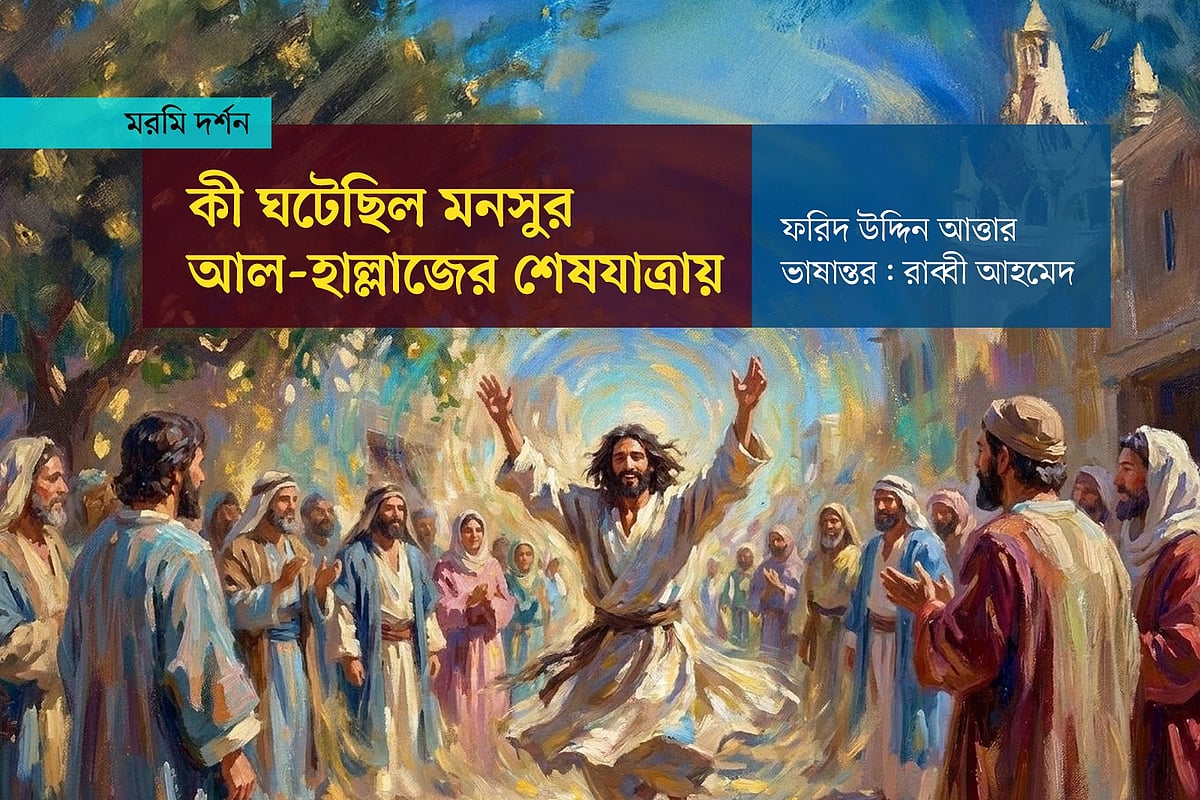
The article recounts the life and controversial end of Mansur Al-Hallaj, a Persian mystic and poet from the 9th-10th centuries, whose story is featured in Fariduddin Attar's "Tadhkirat al-Awliya" (Biographies of the Saints). Al-Hallaj, born Abu al-Mughith al-Husayn ibn Mansur al-Hallaj around 858 CE in Fars province, was a prolific traveler who visited numerous regions including Persia, Arabia, India, and Turkestan. He eventually settled in Baghdad, where his bold declarations of unity with God led to accusations of incarnationism. Consequently, he was arrested, sentenced to death, and brutally executed on March 28, 922 CE. Despite his controversial fate, Al-Hallaj became an enduring symbol of self-devotion in the divine love within Islamic folklore.
His early life involved periods of spiritual seeking with prominent Sufis like Sahal ibn Abdullah and Junayd of Baghdad. Al-Hallaj's journeys were extensive, marked by intense spiritual experiences and interactions with various religious and intellectual circles. His teachings often delved into the inner mysteries of human existence, earning him the moniker "Al-Hallaj of the Inner Secrets." His unconventional pronouncements and perceived defiance of established religious norms led to increasing scrutiny and opposition from religious scholars and authorities.
Ultimately, his famous utterance "Ana al-Haqq" (I am the Truth), interpreted by many as a claim of divinity, became the primary charge leading to his execution. Even his mentor, Junayd of Baghdad, despite a complex relationship with Al-Hallaj, ultimately sanctioned his execution, stating, "Kill him. Now is not the time to search for hidden meanings." Al-Hallaj's final moments in prison are described with mystical accounts of his transcendence, where he allegedly freed fellow prisoners and demonstrated supernatural abilities before his execution, leaving behind a legacy as one of Islam's most debated spiritual figures.
The narrative surrounding Mansur Al-Hallaj highlights a recurring tension in religious and philosophical traditions: the conflict between mystical expression and institutional dogma. Al-Hallaj's insistence on direct, unmediated experience of the divine, articulated through potentially provocative language like "Ana al-Haqq," challenged the established interpretive frameworks of his time. The response from religious authorities, particularly the emphasis on outward adherence to religious law and the dismissal of deeper symbolic meaning, reflects a systemic prioritization of order and control over individual spiritual exploration. This dynamic, where radical personal conviction clashes with communal norms and legal structures, has played out throughout history and continues to shape discussions on religious freedom, interpretation, and the boundaries of theological expression in the digital age, where diverse interpretations can rapidly proliferate and confront established narratives.
AI-generated to prompt reflection — not editorial opinion, not advice, not a statement of fact. How this works.