Thousands of Femtosats Proposed for In-Situ Exploration of Saturn's Rings and Atmosphere
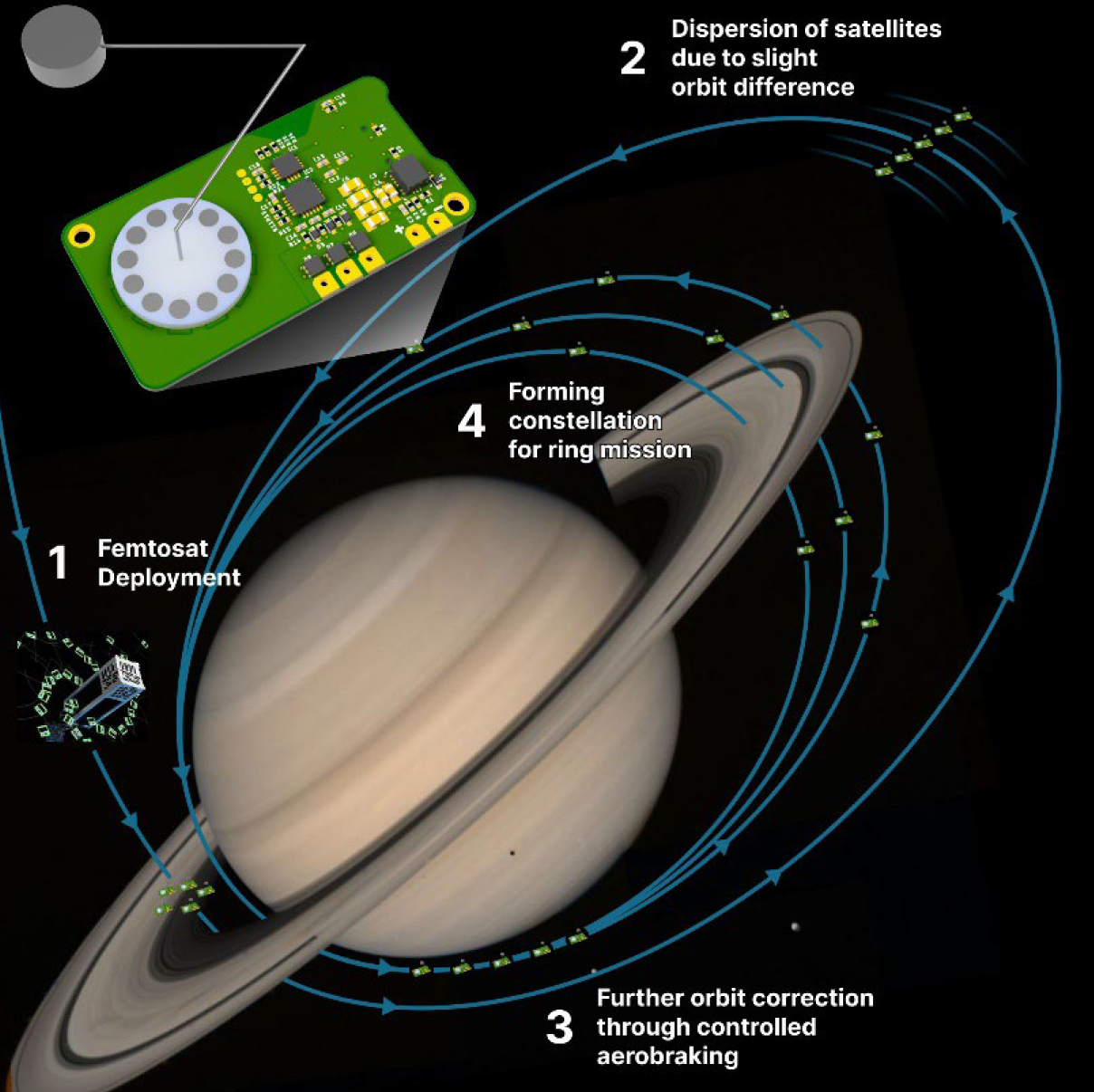
Northwestern University researcher Michael Rubenstein has proposed a novel mission concept utilizing approximately 10,000 actively steerable femtosatellites for the in-situ exploration of Saturn. The primary objectives of this ambitious mission would be to map the composition of Saturn's rings, analyze the atmospheric composition and density, and chart the distribution of its magnetic field. The proposal highlights the significant risks associated with using a single, large flagship mission, such as the Cassini probe, for such detailed surveys, citing the potential for catastrophic mission failure. The femtosatellite swarm approach aims to mitigate these risks by distributing the exploration capabilities across a vast number of small, independently steerable units. This distributed architecture could provide unprecedented data resolution and redundancy, enhancing the scientific return while improving mission resilience.
The proposed femtosatellite constellation offers a paradigm shift from traditional monolithic space missions towards distributed, swarm-based exploration. This approach leverages technological advancements in miniaturization and autonomous control to address the inherent risks and limitations of single-point-of-failure designs. By deploying thousands of small, steerable units, the mission aims to achieve comprehensive in-situ data collection with enhanced redundancy. Future space exploration architectures may increasingly rely on such swarm intelligence, enabling more robust and cost-effective scientific investigations of complex planetary systems. The challenge lies in the intricate coordination and communication required for such a large, autonomous swarm operating in a harsh environment, presenting significant engineering and operational hurdles.
AI-generated to prompt reflection — not editorial opinion, not advice, not a statement of fact. How this works.