Thousands protest AfD's rise as far-right party eyes power in Germany
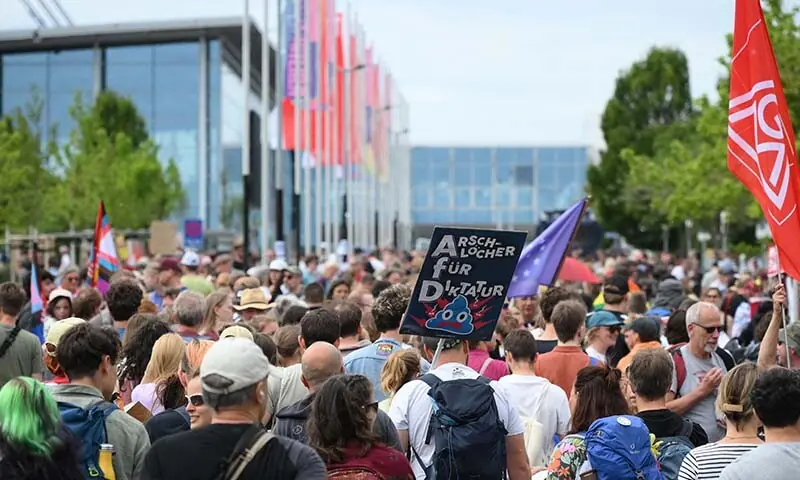
Thousands of protesters gathered in Erfurt, Germany, on Saturday to demonstrate against the far-right Alternative for Deutschland (AfD) party and disrupt its annual conference. The demonstrators, comprising members of unions, civil society groups, and left-wing parties, blocked roads leading to the convention center. Police deployed significant reinforcements to manage the estimated 15,000 participants in the protests. The AfD used the conference to re-elect its current leaders, Alice Weidel and Tino Chrupalla, who have presided over the party's increasing national influence. Weidel and Chrupalla have positioned the AfD as a national force, currently leading in opinion polls ahead of Chancellor Friedrich Merz's conservative party. In their speeches, the AfD leaders criticized the protesters as anti-democratic and emphasized the party's growing support, suggesting it could win regional elections this year and potentially gain national power. Weidel stated that the party represents the last chance to save Germany and fight for its identity, while Chrupalla expressed confidence in the party's future governance at both regional and national levels. The party's platform includes stringent immigration policies, with slogans like 'Send them back' and merchandise indicating deportations being promoted. AfD leaders deny opposing democratic principles and recently secured a court order against the domestic intelligence service's classification of the party as 'extremist.' The AfD's surge is particularly strong in eastern Germany, where voter disillusionment with traditional parties is high, with recent polls showing the AfD with up to 29% support compared to the conservatives' 22%.
The AfD's strategy appears to leverage public dissatisfaction with established political parties and economic conditions, particularly in eastern Germany. By focusing on nationalist rhetoric and stringent immigration policies, the party taps into anxieties about national identity and security. The re-election of its leaders and their assertive messaging suggest a consolidation of power and a clear intent to challenge the existing political order. The significant counter-protests highlight a deep societal division regarding the AfD's ideology and its potential impact on Germany's democratic values and international relations. The party's success in polls, despite mainstream parties' attempts to isolate it, indicates a potential shift in the German political landscape, driven by a segment of the electorate seeking alternatives to current governance.
AI-generated to prompt reflection — not editorial opinion, not advice, not a statement of fact. How this works.