Three 'Boro Jahangir Bahini' members surrender in Sundarbans, rescue fisherman
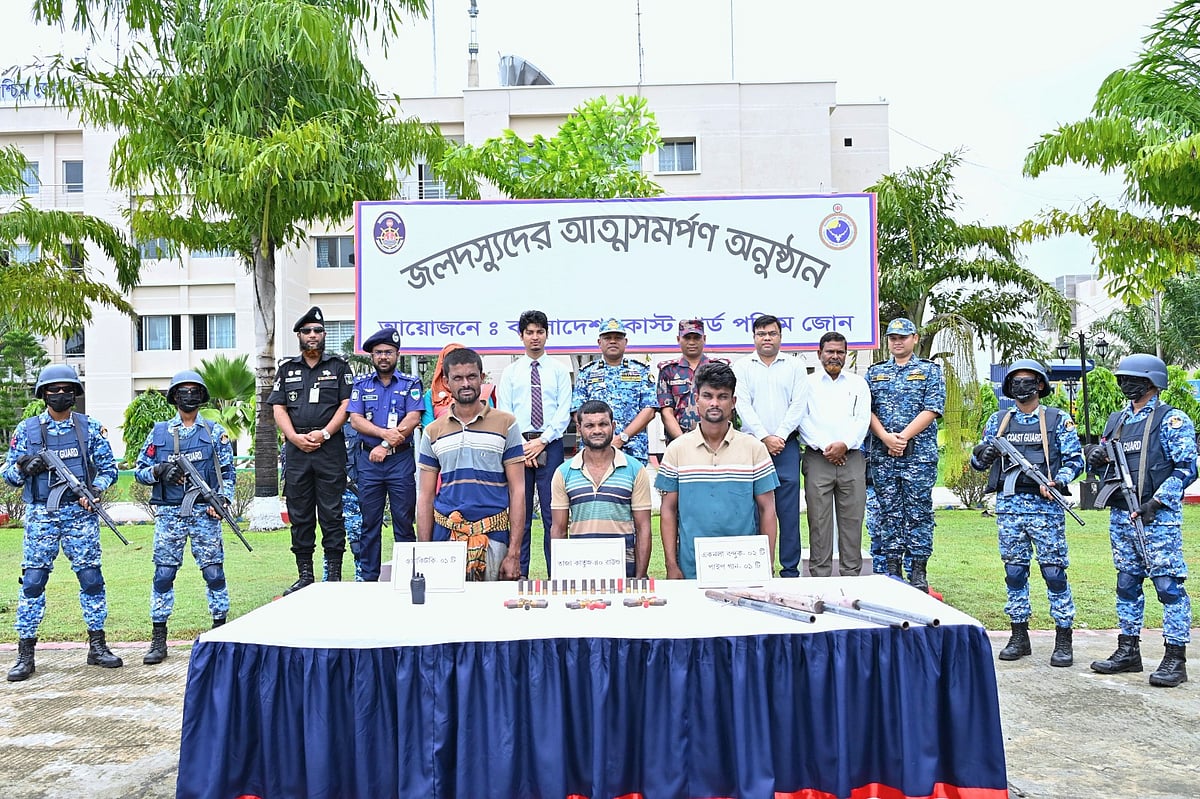
In a significant development within the Sundarbans mangrove forest, three members of the notorious 'Boro Jahangir Bahini' (Boro Jahangir Gang) have surrendered to the Coast Guard, bringing an end to their criminal activities. The surrender occurred on Wednesday afternoon, May 15th, near the Kulamuli canal adjacent to the Tambulbunia Forest Office in Sharankhola police station, Bagerhat. The surrendered individuals, identified as Alamin Hossain (40) from Mongla, Bagerhat; Teybur Rahman (24) from Tala, Satkhira; and Moniruzzaman Mamun (20) from Koyra, Khulna, handed over two single-barreled local guns, one local pipe gun, 40 live cartridges, and a walkie-talkie. Crucially, during their surrender, the Coast Guard also successfully rescued a fisherman who had been held hostage by the gang. The Coast Guard stated that these individuals were involved in piracy, abducting fishermen and honey collectors (bawalis) for ransom within the Sundarbans for an extended period. This surrender is part of ongoing special operations, 'Operation Restore Peace in Sundarbans' and 'Operation Mangrove Shield,' aimed at curbing forest banditry and ensuring the safety of forest dwellers. Since February 12th, these operations have led to the recovery of 49 firearms, 10 bullets, 316 cartridges, 108 empty cartridges, 194 airgun pellets, and two walkie-talkies. Additionally, 42 pirates have been apprehended, and 41 hostages have been rescued. In a separate incident, seven members of the 'Choto Sumon Bahini' (Choto Sumon Gang) also previously surrendered. Legal proceedings for the rehabilitation of the surrendered pirates, the confiscated weapons, and the handover of the rescued fisherman to his family are currently underway. Coast Guard officials have urged active pirates to surrender and return to normal life, warning that those who continue criminal activities will face stricter legal action under the government's 'zero tolerance' policy.
The surrender of pirates in the Sundarbans, facilitated by Coast Guard operations, highlights the persistent challenge of organized crime in ecologically sensitive and remote regions. The Coast Guard's 'zero tolerance' policy and ongoing operations demonstrate a strategic approach to restoring order and protecting vulnerable communities. The rehabilitation program for surrendered pirates suggests a recognition of the complex socio-economic factors that may drive individuals to piracy, aiming to disrupt the cycle of crime. Looking ahead, sustained inter-agency cooperation and community engagement will be crucial to address the root causes of piracy and ensure long-term security and ecological preservation in the Sundarbans, particularly as climate change impacts may exacerbate resource scarcity and displacement.
AI-generated to prompt reflection — not editorial opinion, not advice, not a statement of fact. How this works.