Tomesphere: 8 Million Scientific Papers Now Available for AI and Human Researchers
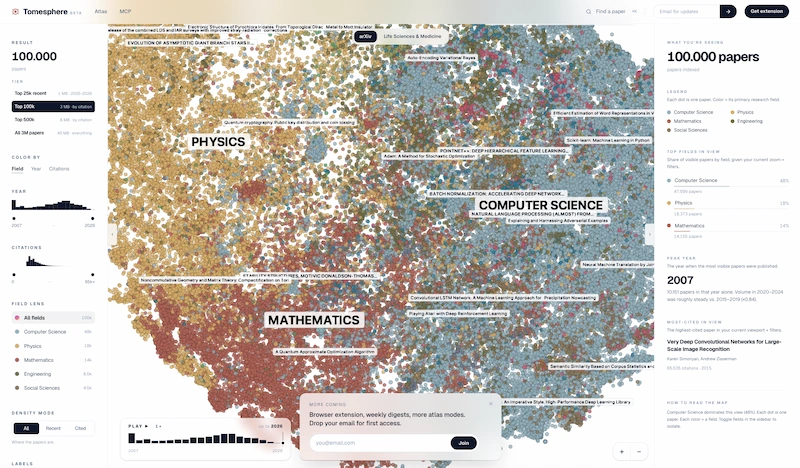
Tomesphere has launched a new platform designed to allow AI agents to directly process scientific literature, eliminating the need to extract text from PDFs or Word documents. The platform aggregates over 8 million scientific articles from six major repositories: arXiv, PMC, bioRxiv, medRxiv, eLife, and F1000. It provides data in various formats optimized to reduce token usage and costs, while also offering human-readable PDFs for those who prefer them. Tomesphere automatically links each publication to related resources, aiming to transform scientific papers into structured knowledge units. Currently, it contains 402,000 peer-reviewed works, 146 million medical entity mentions, 1.58 million gene-related articles, and 132,000 clinical trials. The content is organized into approximately 25,000 semantic clusters, facilitating navigation. Each paper includes an automatic summary, links to associated code and models on platforms like GitHub and Hugging Face, indicators for open reviews, retractions, and impact factors, and in some instances, explanatory videos. While primarily intended as a data source for AI models such as ChatGPT, Claude, Perplexity, Bing, and Gemini, the platform is also accessible to human researchers. Tomesphere acts as an additional metadata layer, enhancing the efficiency of analyzing scientific literature for both humans and AI.
The development of platforms like Tomesphere signifies a pivotal shift in how scientific knowledge is accessed and utilized, particularly with the rise of generative AI. By structuring and indexing millions of research papers, Tomesphere aims to democratize access to complex information and accelerate discovery. This initiative highlights the growing symbiosis between human intellect and artificial intelligence in scientific exploration. However, the efficacy of AI in interpreting nuanced scientific findings and the potential for over-reliance on automated summaries warrant careful consideration. Ensuring the integrity of the data, including accurate representation of peer review status and retractions, will be critical for maintaining scientific rigor. As AI models become more integrated into research workflows, ethical frameworks governing data usage and intellectual property will need to evolve to address the challenges posed by this new era of AI-assisted scholarship.
AI-generated to prompt reflection — not editorial opinion, not advice, not a statement of fact. How this works.