Tomesphere: AI-Ready Scientific Papers and Human-Readable Summaries
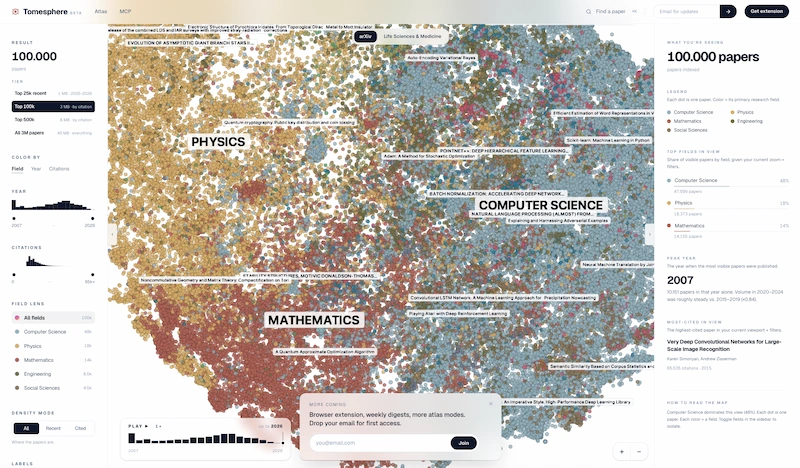
Tomesphere is a new platform designed to enable AI agents to directly process scientific literature, bypassing the need to extract text from PDFs or Word documents. It aggregates over 8 million scientific articles from six repositories: arXiv, PMC, bioRxiv, medRxiv, eLife, and F1000. The platform aims to reduce and lower the cost of token usage by presenting information in various formats, while also providing human-readable PDFs for those who prefer them. Tomesphere automatically links each publication to related resources, creating a structured knowledge base. It currently holds 402,000 peer-reviewed papers, 158 million mentions of gene articles, 132,000 clinical trials, and 146 million mentions of medical entities. The content is organized into approximately 25,000 semantic clusters, offering an intuitive navigation experience. Each paper includes an automatic abstract, links to associated code and models on platforms like GitHub and Hugging Face, confidence indicators for open reviews, retractions, and impact metrics, and in some cases, explanatory videos. The core concept is to transform scientific articles into structured knowledge units, primarily intended as data for AI models like ChatGPT, Claude, Perplexity, Bing, and Gemini, but also accessible to human researchers. This initiative represents a significant step towards more efficient analysis of scientific literature through a collaborative metadata layer.
The development of platforms like Tomesphere signifies a critical inflection point in how scientific knowledge is accessed and utilized. By structuring vast quantities of research papers into AI-consumable formats, it addresses the growing challenge of information overload and accelerates potential discovery cycles. This approach leverages AI's capacity for rapid pattern recognition and synthesis, potentially democratizing access to complex research for both artificial and human intelligences. However, the efficiency gains must be balanced against the need for rigorous human oversight and critical evaluation of AI-generated insights. The long-term impact will depend on how effectively these systems can maintain scientific integrity, mitigate algorithmic bias, and foster genuine understanding rather than mere data processing within the evolving landscape of AI-driven research.
AI-generated to prompt reflection — not editorial opinion, not advice, not a statement of fact. How this works.