Top 50 AI and Embodied Intelligence Companies for 2026 Revealed by 36Kr
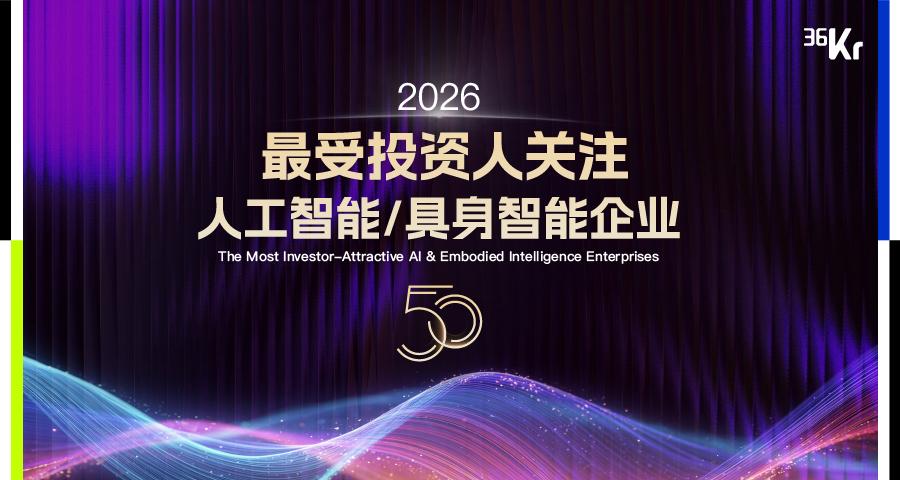
A new industrial cycle is emerging in artificial intelligence, with rapid advancements in large models, generative AI, multimodal interaction, and intelligent agents. Embodied intelligence, in particular, is transitioning from early exploration to industrial validation, with robots becoming key interfaces between AI and the physical world. The Chinese embodied intelligence market is projected to exceed one trillion yuan by 2026, with significant growth in investment, reaching 93.5 billion yuan in the first half of 2026, a nearly fivefold increase from the previous year. However, challenges like business model homogenization and the risk of product duplication are present, as noted by research institutions and government bodies.
The AI industry's development has shifted from being model-driven to application-driven, emphasizing the integration of technology with specific industries to create value. Companies are increasingly focusing on deep industry knowledge and the ability to translate general AI capabilities into tailored solutions. For embodied intelligence, the focus is on robots understanding environments, completing tasks, and continuous evolution through breakthroughs in perception, decision-making, control, and hardware. Key trends include accumulating real-world data, enhancing supply chain collaboration across algorithms, hardware, and applications, and prioritizing commercialization over mere technical prowess.
Investor focus has shifted from technological potential to proven revenue generation and competitive moats. Successful AI companies now demonstrate long-term technological vision, a robust commercial loop with clear customer needs, and comprehensive team capabilities beyond just engineering. The industry is moving from rapid expansion to rational, deep cultivation, with an emphasis on companies that can achieve scalable applications and sustained value creation. The "Top 50 Most Watched AI/Embodied Intelligence Companies for 2026" list by 36Kr aims to identify these key players transitioning from concept to value validation.
The AI sector is experiencing a significant transition, moving beyond foundational model development to practical, industry-specific applications, particularly in embodied intelligence. While market forecasts indicate substantial growth and investment, the industry faces challenges related to business model standardization and the need for genuine differentiation beyond generic AI capabilities. The emphasis is shifting towards companies that possess deep domain expertise and can effectively integrate AI into complex industrial processes, rather than those solely focused on technological novelty. Investors are increasingly prioritizing demonstrable commercial viability and sustainable business models, signaling a maturation of the AI investment landscape. Future success will likely depend on a company's ability to navigate the complexities of real-world deployment, including cost, stability, and user demand, moving from a phase of concept validation to one of tangible value creation.
AI-generated to prompt reflection — not editorial opinion, not advice, not a statement of fact. How this works.