TranscEngram Secures Hundreds of Millions in Angel Funding for Robot Memory Systems
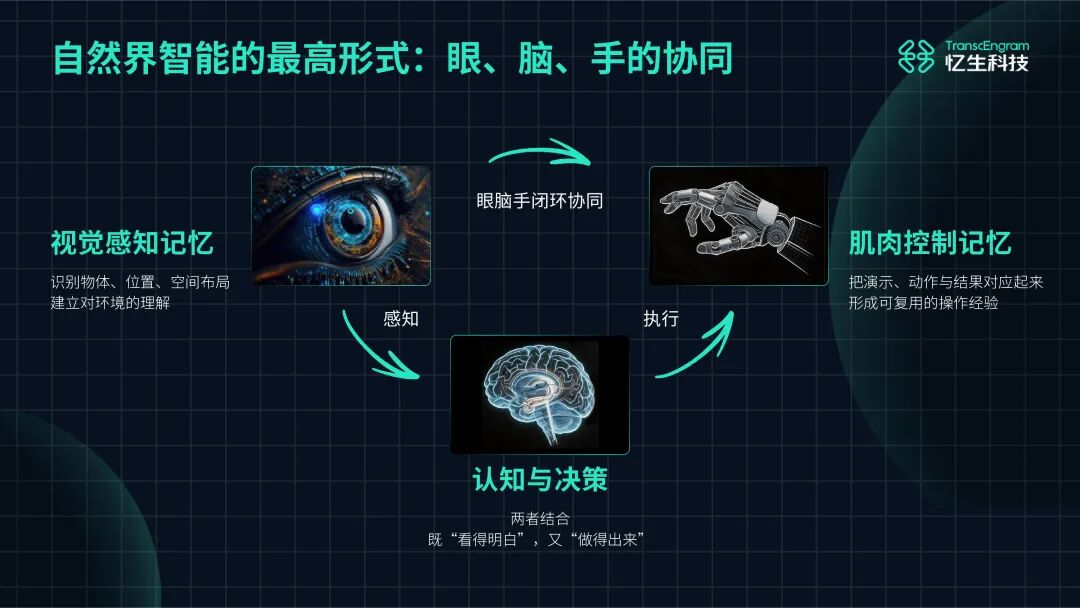
TranscEngram, a startup co-founded by leading AI experts from the University of Hong Kong, has successfully raised hundreds of millions of yuan in an angel funding round. The investment, which included participation from industrial and state-backed capital, will fuel the development of a unified 'brain and cerebellum' system for robots, aiming to create a novel memory system for autonomous intelligence. The company's core technology focuses on a 'perception-prediction-interaction' loop, designed to imbue robots with a more human-like learning process. This approach contrasts with current large language models, which Professor Ma Yi, a co-founder, describes as static knowledge repositories prone to 'hallucinations' due to a lack of real-world validation. TranscEngram's system comprises a 'visual memory' for understanding the environment and a 'muscle memory' for precise motor control, enabling robots to learn and adapt through continuous interaction. The company highlights significant performance improvements, with its memory-based architecture reportedly achieving over three times better average performance across multiple tasks compared to traditional models, with a success rate exceeding 95%. This memory mechanism is designed to be transferable across different robotic embodiments, overcoming previous limitations that required extensive reprogramming for new scenarios or tools. TranscEngram is targeting commercial applications in high-end hotel services, such as room cleaning and delivery, and flexible assembly in advanced manufacturing sectors like aerospace, aiming to provide a robust, self-correcting, and continuously evolving intelligent system for robots. The company has established R&D centers in Shanghai, Shenzhen, and other locations, and is actively collaborating with other robotics firms.
TranscEngram's pursuit of a 'memory system' for robots addresses a critical bottleneck in current AI development: the gap between static knowledge and dynamic, real-world interaction. By emphasizing a closed-loop learning process inspired by biological systems, the company aims to create more adaptable and robust autonomous agents. This approach could potentially mitigate issues like AI hallucination and improve generalization capabilities, moving beyond task-specific programming. The success of this venture will likely hinge on the efficacy of its 'brain and cerebellum' architecture in achieving true 'zero-shot' learning and seamless skill transfer across diverse robotic platforms. The long-term implications for human-robot collaboration and the future of automated industries, particularly in complex, unstructured environments, warrant close observation as this technology matures.
AI-generated to prompt reflection — not editorial opinion, not advice, not a statement of fact. How this works.