Trump Administration's Policies Threaten to Stifle Federally Funded Scientific Research
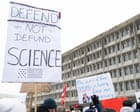
New policies enacted by the Trump administration are poised to significantly disrupt established scientific research practices in the United States. These measures appear to mirror strategies used to gradually privatize public services by systematically underfunding and creating administrative burdens that render institutions barely functional.
Federal funding agencies, including the National Institutes of Health (NIH), are reportedly experiencing grant freezes and administrative chaos. Furthermore, political appointees are implementing new review processes that scrutinize research for specific keywords like "disparity" and "marginalized." Proposed restrictions also aim to impede international scientific collaboration. The cumulative effect of these actions could make conducting federally funded research excessively difficult, potentially leading scientists to abandon such endeavors. Daniel Malinsky, an assistant professor of biostatistics at Columbia University's Mailman School of Public Health, suggests these policies may be designed to make the process so arduous that researchers are discouraged from continuing.
The described policy shifts at federal research funding agencies raise questions about the long-term sustainability and efficacy of scientific inquiry in the United States. By introducing new layers of administrative review and potentially restricting collaboration, these measures could inadvertently increase the friction for researchers, impacting the pace of innovation and discovery. This approach, if intentional, could be viewed as a strategy to disincentivize federally funded research, potentially creating an environment where private sector or alternative research models become more attractive. Evaluating the incentive structures and governance frameworks within scientific funding is crucial to ensure that policy decisions support, rather than hinder, the advancement of knowledge and address societal challenges effectively over the next decade.
AI-generated to prompt reflection — not editorial opinion, not advice, not a statement of fact. How this works.